
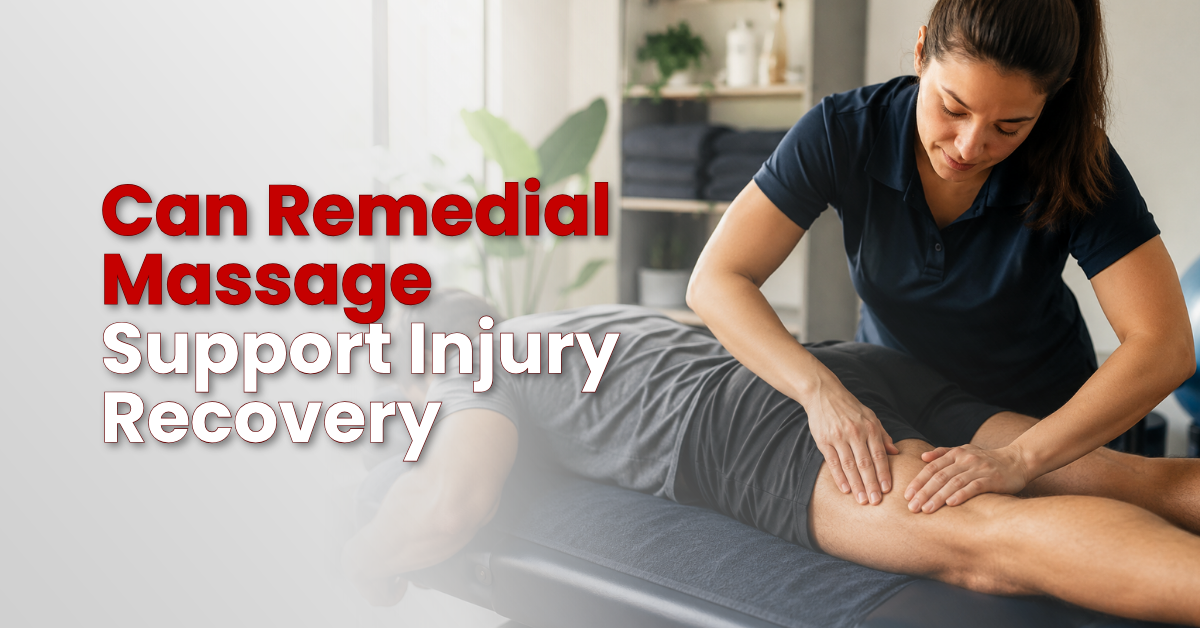
Short answer: yes, remedial massage can play a useful supporting role in injury recovery, and the key word is supporting.
Massage is one of the oldest treatments there is, and also one of the most oversold. Somewhere between “massage fixes everything” and “massage is just relaxation” sits the honest picture: research supports real, mostly short-term benefits, and used well, those benefits can make the rest of your recovery work better.
Here’s what remedial massage genuinely offers during injury recovery, what it doesn’t, and where it fits in a well-built plan.
What Is Remedial Massage?
Remedial massage is targeted, assessment-based soft tissue treatment. Unlike a general relaxation massage, a remedial therapist works with a specific purpose, addressing particular muscles and areas of tension connected to your problem, using techniques like deep tissue work, trigger point therapy and assisted stretching, adjusted to what your body needs that day.
In an injury context, it’s typically used alongside other treatment rather than on its own.
What the Evidence Supports
Massage research has grown considerably, and the findings are consistent in both directions, worth knowing honestly:
- Short-term relief for common musculoskeletal problems. A systematic review found massage therapy provides short-term benefits for pain and function in common musculoskeletal conditions compared to no treatment
- Reduced post-exercise soreness. A large meta-analysis of recovery techniques found massage was among the most effective for reducing delayed-onset muscle soreness and perceived fatigue after training
- Modest benefits for low back pain. Cochrane’s review found massage may provide short-term relief for low back pain, particularly when combined with exercise and education
- Possible effects on inflammation. Early research suggests massage may influence inflammatory signalling in muscle after hard exercise, though this science is still developing
The pattern across all of it: genuine benefits, mostly short-term, and strongest when massage is paired with active treatment rather than standing alone.
What Massage Doesn’t Do
An honest practitioner will tell you these plainly:
- It doesn’t speed up tissue healing. A healing muscle, tendon or ligament repairs on its own biological timeline. Massage can make that period more comfortable, but it doesn’t shortcut it
- It doesn’t replace strengthening. Injured tissue regains its capacity through progressive loading. No amount of hands-on work substitutes for that
- Its effects fade without follow-up. Relief that lasts days is valuable, but only if you use the window it creates
None of this makes massage less worthwhile. It makes the case for using it the right way.
Where Massage Fits in Injury Recovery
Used well, remedial massage earns its place in a recovery plan in a few specific ways:
Easing the Tension Around an Injury
Injuries rarely stay contained. When something hurts, surrounding muscles often tighten protectively, and compensating movement loads other areas, the opposite hip, the other calf, the neck and shoulders. Massage may help ease this secondary tension, which often accounts for a surprising share of the overall discomfort.
Creating a Window for Rehabilitation
Short-term relief is more useful than it sounds. A few days of reduced pain and tension can be exactly the window in which rehab exercises feel achievable rather than daunting, and moving better, sooner, is itself part of recovering well.
Supporting Recovery Between Training Sessions
For people rebuilding their training load after injury, massage may help manage the soreness and tightness that come with reintroducing exercise, making it easier to stay consistent with the plan.
Keeping an Eye on the Whole Picture
A good remedial therapist notices things, a calf that’s always tight on one side, tension patterns that suggest your desk setup or technique needs attention, and in a team environment can flag them to your physiotherapist or chiropractor before they become the next problem.
When Massage Isn’t the Right First Step
Massage works best on a problem that’s been properly assessed. It’s not the right starting point when:
- An injury is new, severe or undiagnosed, assessment comes first, and some acute injuries shouldn’t be massaged at all in the early days
- There’s significant swelling, suspected fracture, numbness or unexplained symptoms, which need medical assessment
- It’s being used to repeatedly silence a recurring problem that actually needs rehabilitation, if you need the same spot released every fortnight, that spot is asking for a strength program
Remedial Massage at Next Phase Injury Therapy
At Next Phase Injury Therapy in Yagoona, our remedial massage therapists work in the same team as our physiotherapists and chiropractors, which is exactly how massage delivers its best value, coordinated with your rehabilitation rather than separate from it.
We work with you to:
- Use massage where it genuinely helps your recovery, and tell you honestly where it won’t
- Time sessions around your rehab and training so the short-term benefits get used
- Share information across your treating team so nothing gets missed
Ready to Put Massage to Work Properly?
If you’re recovering from an injury and wondering whether remedial massage belongs in your plan, an assessment is the right place to start.
Explore our remedial massage, physiotherapy, chiropractic and clinical Pilates services, or book an appointment with Next Phase Injury Therapy. We’re open 8am to 8pm, seven days a week. Yes, even Sundays.
References
- Bervoets, Diederik C., et al. “Massage Therapy Has Short-Term Benefits for People with Common Musculoskeletal Disorders Compared to No Treatment: A Systematic Review.” Journal of Physiotherapy, vol. 61, no. 3, 2015, pp. 106–116, https://doi.org/10.1016/j.jphys.2015.05.018.
- Dupuy, Olivier, et al. “An Evidence-Based Approach for Choosing Post-Exercise Recovery Techniques to Reduce Markers of Muscle Damage, Soreness, Fatigue, and Inflammation: A Systematic Review with Meta-Analysis.” Frontiers in Physiology, vol. 9, 2018, https://doi.org/10.3389/fphys.2018.00403.
- Poppendieck, Wigand, et al. “Massage and Performance Recovery: A Meta-Analytical Review.” Sports Medicine, vol. 46, no. 2, 2016, pp. 183–204, https://doi.org/10.1007/s40279-015-0420-x.
- Furlan, Andrea D., et al. “Massage for Low-Back Pain.” Cochrane Database of Systematic Reviews, no. 9, 2015, https://doi.org/10.1002/14651858.CD001929.pub3.
- Crane, Justin D., et al. “Massage Therapy Attenuates Inflammatory Signaling after Exercise-Induced Muscle Damage.” Science Translational Medicine, vol. 4, no. 119, 2012, https://doi.org/10.1126/scitranslmed.3002882.
Information on this page is general in nature and is not a substitute for individualised advice from a registered health practitioner. Our practitioners are registered with AHPRA.


