
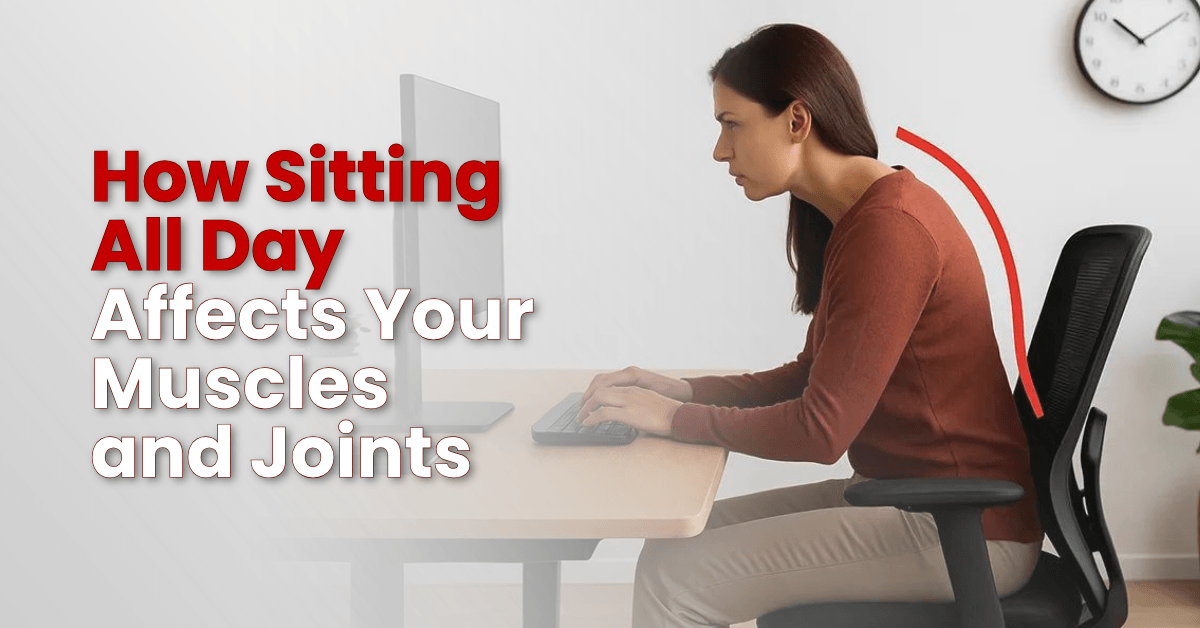
Sitting is part of everyday life for a lot of people. You might spend hours at a desk, sit through a long commute, work from home, study, drive between appointments or relax in front of a screen after work.
The issue is not that sitting is automatically harmful. The bigger problem is spending long periods in the same position with very little movement.
When that happens regularly, muscles can feel stiff, joints can become less comfortable, and your body may become less prepared for the lifting, walking, training and everyday movement you expect from it.
Here is how prolonged sitting can affect your muscles and joints, why discomfort can build up, and what you can do to keep your body moving well.
What Happens to Your Body When You Sit All Day?
Sitting itself is normal. Your body is capable of sitting, just like it is capable of standing, walking and lying down.
Problems can develop when sitting becomes the position you spend most of your waking day in.
Long periods of sitting usually mean:
- Your hips and knees stay in similar positions for hours
- Your trunk and back muscles do less active work
- Your shoulders and neck may stay relatively still
- Your legs spend less time walking, pushing and carrying load
- Your overall daily movement drops
Over time, this can contribute to stiffness, reduced movement variety and lower physical capacity if regular exercise and movement are also limited.
Sedentary behaviour is defined as waking time spent sitting, reclining or lying with low energy expenditure, and global health guidance recommends limiting prolonged sedentary time and replacing some of it with physical activity.
Can Sitting Too Long Cause Muscle and Joint Pain?
Sitting for long periods can be associated with musculoskeletal pain, particularly when it is combined with low physical activity, repetitive work demands or limited opportunities to change position.
Research has found associations between sedentary behaviour and musculoskeletal pain, although the relationship is not as simple as saying that sitting directly damages your muscles or joints.
Pain is influenced by many factors, including:
- How long you stay in one position
- Your overall activity level
- Muscle strength and endurance
- Previous injuries
- Workstation setup
- Sleep and recovery
- Stress
- How physically demanding the rest of your day is
The goal is not to find one “perfect” sitting position. It is usually more useful to create more movement throughout the day.
How Sitting Affects Your Lower Back
Lower back stiffness is one of the most common complaints people associate with desk work.
When you sit for a long time, your spine remains in a relatively fixed position and the muscles around the trunk are not being challenged through much variety.
You may notice:
- Lower back stiffness when standing up
- An ache after several hours at a desk
- Discomfort during long drives
- Feeling better after walking or stretching
- Reduced tolerance for sitting as the day progresses
This does not necessarily mean sitting has damaged your back.
Back pain is influenced by many factors, and there is no single posture that guarantees pain or prevents it. A position that feels comfortable for 20 minutes may become uncomfortable after several hours simply because your body wants movement.
How Sitting Affects Your Hips
Your hips spend much of the day flexed when you are sitting.
After several hours, you may notice that the front of your hips feels tight or that standing upright feels stiff when you first get out of your chair.
Long periods of inactivity can also mean the muscles around the hips are simply doing less work.
You may notice:
- Hip stiffness after sitting
- Tightness through the front of the hip
- Glute weakness or fatigue during exercise
- Discomfort when standing after a long drive
- Difficulty moving comfortably into deeper squats or lunges
It is important to distinguish between feeling tight and having permanently shortened muscles. Often, what feels like “tight hip flexors” is influenced by spending too much time in one position rather than the muscle physically becoming stuck that way.
Regular walking, strength training and changing positions can usually be more useful than stretching alone.
What Happens to Your Glutes When You Sit Too Much?
You may have heard phrases like “dead butt syndrome” or claims that sitting switches your glutes off.
That description is exaggerated.
Your glute muscles do not simply stop working because you sit at a desk. However, if you spend most of the day sitting and do very little strength or physical activity, your glutes may not receive enough regular loading to maintain the strength and endurance you need for other tasks.
Glute strength is important for:
- Walking
- Running
- Climbing stairs
- Squatting
- Lifting
- Hip stability
- Balance
The answer is not necessarily dozens of glute activation exercises during work. Regular strength training and simply moving more throughout the week can be more meaningful.
How Sitting Affects Your Neck and Shoulders
Neck and shoulder discomfort is common in people who work at computers for long periods.
It can build when you spend hours looking at the same screen, reaching for a mouse or working from a setup that does not allow much position change.
You may notice:
- Neck stiffness
- Shoulder tension
- Upper back aching
- Headaches
- Fatigue around the shoulder blades
- Discomfort when turning your head
This is often blamed entirely on poor posture, but posture is only part of the picture.
Even an ergonomically good position can become uncomfortable when held for too long.
Changing positions, taking short movement breaks and building strength through the neck, shoulders and upper back may be more useful than trying to sit perfectly upright for eight hours.
Can Sitting Make Your Knees Stiff?
Yes, some people notice knee stiffness after sitting for long periods.
Keeping the knees bent for hours can make standing up uncomfortable, particularly if you already have knee irritation or reduced activity levels.
You may notice:
- Stiffness when standing after sitting
- Discomfort around the kneecap
- Difficulty taking the first few steps
- Symptoms after long car trips
- Pain after sitting with the knees bent for extended periods
The knee usually benefits from regular movement.
Walking, changing position, strengthening the legs and gradually building activity tolerance can often be more helpful than trying to avoid bending the knee altogether.
Does Sitting All Day Make Your Muscles Weak?
Sitting for one day does not suddenly weaken your muscles.
However, if prolonged sitting is part of an overall inactive lifestyle, muscles receive less regular loading.
Over time, reduced activity can contribute to lower strength and physical capacity.
Areas that may be affected include:
- Glutes
- Quadriceps
- Calves
- Trunk muscles
- Upper back and shoulder muscles
This matters because everyday life still asks these muscles to work.
Carrying groceries, climbing stairs, lifting a child, going hiking or returning to the gym can feel much harder if your body spends most of its week doing very little physical work.
WHO guidance emphasises that adults should reduce sedentary behaviour and that replacing sitting time with physical activity, even light activity, provides health benefits.
Is Sitting Bad for Your Posture?
Sitting does not automatically create “bad posture”.
There is no single perfect posture that everyone needs to maintain throughout the day.
The problem is more often staying in the same posture for too long.
Someone can sit upright with excellent-looking posture and still become uncomfortable after several hours.
Instead of constantly correcting yourself into one rigid position, try to create more variety.
That might mean:
- Sitting back in your chair
- Sitting upright for a while
- Standing occasionally
- Walking around
- Changing where your feet are positioned
- Moving your shoulders and neck
- Alternating between different work positions
A useful posture is often your next posture.
Can Exercise Undo the Effects of Sitting?
Exercise can help address some of the physical effects associated with prolonged inactivity, especially by building strength, fitness and movement capacity.
Useful options can include:
- Walking
- Strength training
- Cycling
- Clinical Pilates
- Swimming
- Mobility exercises
- Recreational sport
But one gym session does not necessarily mean the rest of the day has to be completely inactive.
WHO recommends that adults limit sedentary time and increase physical activity throughout the week. Current guidance also recommends regular aerobic activity and muscle-strengthening exercise.
The practical goal is to combine structured exercise with more everyday movement.
How Often Should You Get Up From Your Desk?
There is no single perfect schedule that works for everybody.
You do not need to panic because you have been sitting for exactly 30 or 60 minutes.
A more realistic approach is simply to avoid staying completely still for hours at a time.
You could try:
- Standing while taking a phone call
- Walking to refill your water bottle
- Taking a short walk during lunch
- Changing position between tasks
- Walking for a few minutes after meetings
- Doing a few squats or calf raises
- Using the stairs when practical
- Parking slightly farther away
- Alternating sitting and standing if you have a suitable desk
Small amounts of movement throughout the day can add up.
The best movement break is usually one you will actually remember and repeat.
Simple Exercises for People Who Sit All Day
You do not need a complicated routine.
A few simple movements can help break up long periods of sitting.
Sit-to-Stand
Stand up from your chair and sit back down with control.
This gives your hips and legs some regular loading during the day.
Calf Raises
Stand behind your chair and slowly rise onto your toes before lowering again.
This gets the calf muscles working after spending time sitting.
Shoulder Blade Movement
Gently move your shoulders forwards, backwards and through a comfortable range rather than holding them rigidly in one position.
Thoracic Rotation
While sitting or standing, gently rotate your upper body from side to side within a comfortable range.
Short Walks
Even a few minutes of walking can change position, load the legs and give your back and hips a break from sitting.
Squats
If comfortable, a few controlled bodyweight squats can provide more movement through the hips, knees and ankles.
These movements are not designed to “fix” sitting. They simply give your body some of the movement variety it has been missing.
Does a Standing Desk Solve the Problem?
A standing desk can be useful, but standing all day is not automatically better than sitting all day.
The body still does not love being stuck in one position for hours.
A standing desk works best as another option rather than the only position you use.
You might alternate between:
- Sitting
- Standing
- Walking
- Short movement breaks
The goal is variety.
Changing position regularly is generally more practical than replacing eight hours of sitting with eight hours of standing.
When Should Muscle or Joint Pain Be Assessed?
It may be worth getting assessed if:
- Pain has lasted more than a few weeks
- Symptoms are getting progressively worse
- Pain keeps returning despite changing your activity
- You have noticeable weakness
- Your movement is becoming increasingly restricted
- Pain is affecting your sleep
- Symptoms interfere with work, exercise or everyday activities
- You have numbness, tingling or pain travelling into an arm or leg
Seek prompt medical care if pain is associated with significant trauma, progressive weakness, loss of bladder or bowel control, numbness around the groin or saddle area, fever, unexplained weight loss or other unusual systemic symptoms.
How Physiotherapy Can Help With Pain From Prolonged Sitting
Physiotherapy can help when stiffness or pain from desk work, driving or prolonged sitting starts interfering with everyday life.
At Next Phase Injury Therapy in Yagoona, treatment may include:
- Assessment of movement, strength and mobility
- Reviewing your work or desk demands
- Advice on movement and position changes
- Strengthening exercises
- Mobility work where appropriate
- Strategies for managing recurring back, neck or shoulder discomfort
- Clinical Pilates where appropriate
- Gradual return to exercise or physical activity
The goal is not to teach you how to sit perfectly.
It is to help your body become strong, mobile and capable enough to handle both sitting and the rest of your day.
Muscle and Joint Pain Treatment at Next Phase Injury Therapy
At Next Phase Injury Therapy in Yagoona, our team helps people dealing with back pain, neck pain, shoulder discomfort, joint stiffness and other problems associated with work and everyday activity.
We work with you to:
- Understand what may be contributing to your symptoms
- Identify movement or workload factors
- Improve strength and mobility
- Build more movement into your day
- Help you return to exercise, work and everyday activities with confidence
If sitting all day is leaving you stiff, sore or uncomfortable, our team can help identify what your body needs rather than simply telling you to “fix your posture”.
Explore our physiotherapy, chiropractic and clinical Pilates services, or book an appointment with Next Phase Injury Therapy. We are located at 444 Hume Highway, Yagoona NSW 2199, and open 8am to 8pm, seven days a week.
Frequently Asked Questions About Sitting All Day
What happens to your muscles when you sit all day?
Long periods of sitting mean many muscles spend less time actively working through a full range of movement. If prolonged sitting is combined with low overall physical activity, strength and endurance can gradually decline.
Can sitting all day cause joint pain?
Prolonged sitting can be associated with musculoskeletal discomfort and may make joints feel stiff, but sitting does not automatically damage your joints. Overall activity levels, strength, movement variety and other individual factors also matter.
Why does my lower back hurt after sitting?
Staying in one position for a long time can make the lower back feel stiff or uncomfortable. Back pain is influenced by many factors, so recurrent or persistent pain should not automatically be blamed on posture alone.
Are tight hips caused by sitting?
Long periods with the hips in the same flexed position can make them feel stiff or tight. Regular walking, movement and strength work can often be more useful than relying only on stretching.
How often should I move if I work at a desk?
There is no universally perfect interval. Aim to avoid remaining completely still for hours at a time and look for realistic opportunities to stand, walk or change position throughout your workday.
Can exercise help if I sit all day?
Yes. Regular walking, strength training, aerobic exercise and other movement can improve fitness and physical capacity. It is also useful to break up prolonged sedentary time throughout the day.
This article provides general information only and is not a substitute for individual clinical assessment or medical advice. Muscle and joint pain can have many causes, and persistent or worsening symptoms should be assessed by an appropriate health professional.
References
- World Health Organization. WHO Guidelines on Physical Activity and Sedentary Behaviour. 2020.
- World Health Organization. “Physical Activity.” WHO.
- Dzakpasu, Francis Q. S., et al. “Musculoskeletal Pain and Sedentary Behaviour in Occupational and Non-Occupational Settings: A Systematic Review with Meta-Analysis.” International Journal of Behavioral Nutrition and Physical Activity, 2021.
Information on this page is general in nature and is not a substitute for individualised advice from a registered health practitioner. Our practitioners are registered with AHPRA.


