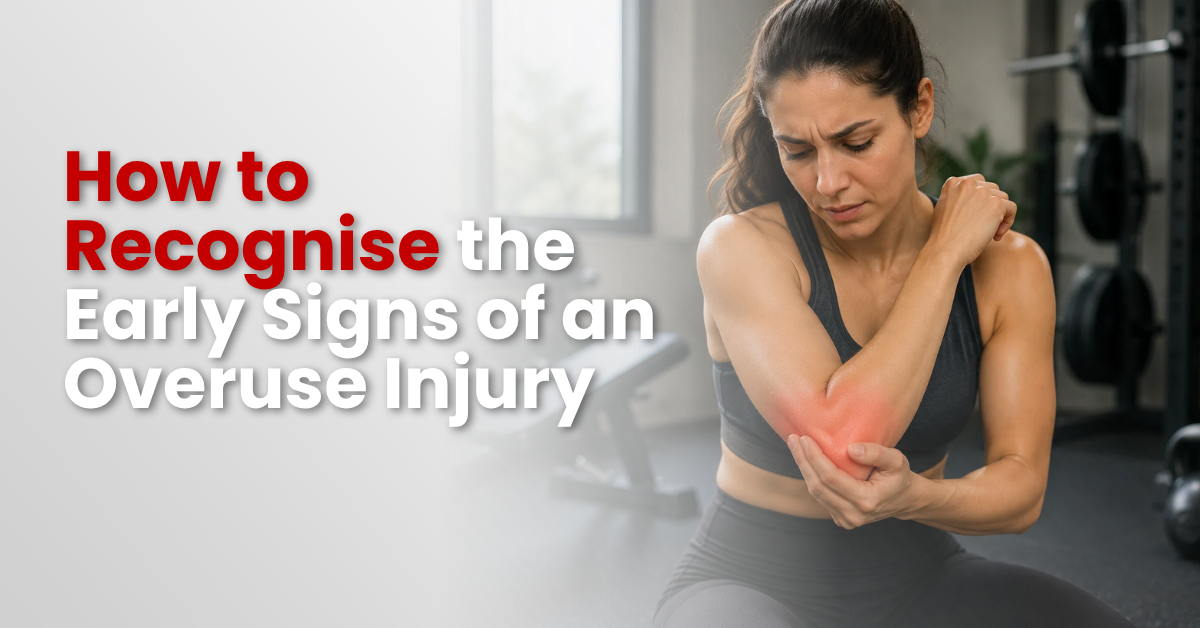
Some injuries announce themselves. A rolled ankle or a pulled hamstring happens in a single moment, and you know exactly when things went wrong.
An overuse injury is different. It builds quietly over weeks or months, one training session at a time, and by the time most people take it seriously, the problem is well established. Sports injury researchers have noted that overuse injuries are routinely under-recognised precisely because people keep training through the early symptoms.
The earlier you catch an overuse injury, the simpler it usually is to manage. Here’s what to look for.
What Is an Overuse Injury?
An overuse injury develops when repetitive load on a tissue outpaces its ability to recover and adapt. No single moment causes it. Instead, small amounts of stress accumulate faster than the body can repair them.
Common examples include:
- Tendinopathies, like Achilles, patellar or tennis elbow
- Shin splints (medial tibial stress syndrome)
- Runner’s knee and other tracking-related knee pain
- Stress reactions in bone
- Plantar fasciopathy (heel pain)
The pattern behind most overuse injury problems is the same: a spike in load, whether that’s a new running program, a return from a break, extra shifts of physical work, or simply doing more of the same thing without enough recovery.
The Early Warning Signs of an Overuse Injury
An overuse injury tends to follow a recognisable progression. The earlier on this ladder you act, the better.
Stage 1: Pain After Activity
The first sign is usually discomfort that shows up after training or work, then settles by the next day. It’s easy to dismiss as normal soreness, but there’s a difference: general muscle soreness is spread across a muscle group and fades within a couple of days, while an early overuse injury tends to be localised to one specific spot and keeps returning after the same activity.
Stage 2: Pain During Activity That Warms Up
Next, the area starts to grumble at the beginning of a session, eases once you’re warm, then often returns afterwards. This warm-up pattern is a classic feature of tendon-related problems and a strong signal that the tissue may be developing an overuse injury in response to its current load.
Recovery is also an important part of managing training load. For more on why recovery matters between sessions, read our guide to fitness recovery.
Stage 3: Pain That Affects Performance
The pain no longer fully warms up. You start modifying, shortening sessions, avoiding certain movements, or favouring one side. If you’re changing how you move to get through activity, the overuse injury is now driving decisions.
Stage 4: Pain at Rest or in Daily Life
Discomfort during everyday tasks, at night or first thing in the morning means the tissue is significantly irritated. Most people seek help at this stage, but an established overuse injury can be harder to manage and may require a longer rehabilitation period.
Other Signs Worth Noticing
Pain isn’t the only signal. Also keep an eye out for signs that may accompany an overuse injury:
- Morning stiffness in one specific area that takes longer and longer to loosen
- Localised tenderness when you press on one precise spot, like the Achilles or the outside of the elbow
- Mild swelling or thickening around a tendon
- Performance decline with no obvious cause, such as pace or strength dropping off
- Persistent fatigue and poor sleep, which can indicate your overall load and recovery are out of balance
Why Catching an Overuse Injury Early Matters
Tendon and overuse problems tend to become more stubborn the longer they’ve been present. Research into tendinopathy describes a continuum, where early, reactive changes in the tissue are more responsive to load management than long-standing changes.
In practical terms, that means:
- Early stage: often manageable with a temporary adjustment to training and a targeted program
- Established stage: usually needs a longer, structured rehabilitation period
- Ignored for months: recovery timeframes can stretch out considerably
Acting when you first notice the signs of an overuse injury can help prevent a small problem from becoming a longer-term issue.
What to Do If You Spot the Signs
If you recognise the early pattern of an overuse injury:
- Adjust the load, don’t necessarily stop. Reducing volume or intensity often settles early symptoms while keeping you active.
- Track the pattern. Note when the pain appears, how long it lasts and what triggers it — this information makes assessment far more useful.
- Review what changed. New program, new shoes, extra sessions, longer shifts, less sleep.
- Get assessed if it persists. If symptoms last more than two to three weeks, keep returning, or are progressing through the stages, it’s time for a professional opinion.
Seek assessment promptly rather than waiting if you notice night pain that doesn’t settle, pain in a bone rather than muscle or tendon, or swelling that appears without explanation.
How Professional Support Can Help With an Overuse Injury
- Physiotherapy: Assesses what’s driving the overload and builds a program to restore the tissue’s capacity
- Chiropractic care: Assesses whether joint mobility or movement patterns are contributing to the load
- Remedial massage: May help ease muscle tension that develops as you compensate
- Dry needling: May assist with trigger points in overworked muscles
- Clinical Pilates: Develops control and strength to support better load distribution
Because an overuse injury is driven by load, assessment looks at your whole picture — training, work, recovery and movement — not just the sore spot. The right approach depends on your individual circumstances.
Catching Problems Early at Next Phase Injury Therapy
At Next Phase Injury Therapy in Yagoona, our physiotherapists, chiropractors and remedial massage therapists regularly see overuse injury presentations in runners, gym-goers, tradies and desk workers alike.
We work with you to:
- Identify what’s driving the overload
- Adjust your training or work demands without stopping everything
- Build the affected area’s capacity so the problem doesn’t keep returning
Noticed a Niggle That Keeps Coming Back?
If something has been grumbling for a few weeks and you keep hoping it will sort itself out, an early assessment can help stop a potential overuse injury becoming a longer-term problem.
Don’t Let a Niggle Become a Bigger Problem
If pain keeps coming back, don’t keep training through it and hope it disappears. An early assessment can help identify what’s contributing to the problem and give you a clear plan forward.
Book an appointment with Next Phase Injury Therapy in Yagoona for personalised support from our physiotherapy, chiropractic, remedial massage and Clinical Pilates team.
FAQs
What are the early signs of an overuse injury?
Early signs can include pain after activity, localised tenderness, stiffness, mild swelling and discomfort that repeatedly returns during the same activity. If the symptoms gradually become more frequent or start affecting your performance, they may indicate an overuse injury rather than normal post-exercise soreness.
Can you keep training with an overuse injury?
In many cases, you may not need to stop all activity. Reducing training volume, intensity or frequency can help manage symptoms while maintaining appropriate movement. The right approach depends on the affected tissue, the severity of your symptoms and what is causing the overload.
How long does an overuse injury take to heal?
Recovery time varies depending on the type and severity of the injury, how long it has been present and how well the contributing factors are managed. An early problem may settle with appropriate load modification, while a more established injury may require a structured rehabilitation program over several weeks or longer.
Should I see a physiotherapist for an overuse injury?
A physiotherapist can assess your symptoms, identify factors contributing to the overload and develop an individualised rehabilitation program. Assessment can be particularly useful when pain keeps returning, affects your performance or starts interfering with everyday activities.
What causes overuse injuries?
Overuse injuries can develop when repetitive physical load exceeds the body’s ability to recover and adapt. Common contributing factors include sudden increases in training, inadequate recovery, repetitive work, changes in activity, poor load management and returning to exercise too quickly after a break.
Is pain after exercise always an overuse injury?
No. Some muscle soreness after unfamiliar or demanding exercise is normal and generally settles with recovery. Pain that is localised, repeatedly occurs in the same area, progressively worsens or begins affecting movement is more concerning and may warrant assessment.
When should I get an overuse injury assessed?
Consider professional assessment if symptoms continue for more than two to three weeks, repeatedly return, progressively worsen or begin affecting your training, work or daily activities. Seek prompt medical assessment for significant swelling, unexplained pain, persistent night pain or pain that appears to be coming from a bone.
References
- Bahr, Roald. “No Injuries, but Plenty of Pain? On the Methodology for Recording Overuse Symptoms in Sports.” British Journal of Sports Medicine, vol. 43, no. 13, 2009, pp. 966–972.
- Clarsen, Benjamin, et al. “Development and Validation of a New Method for the Registration of Overuse Injuries in Sports Injury Epidemiology: The Oslo Sports Trauma Research Centre (OSTRC) Overuse Injury Questionnaire.” British Journal of Sports Medicine, vol. 47, no. 8, 2013, pp. 495–502.
- Cook, Jill L., and Craig R. Purdam. “Is Tendon Pathology a Continuum? A Pathology Model to Explain the Clinical Presentation of Load-Induced Tendinopathy.” British Journal of Sports Medicine, vol. 43, no. 6, 2009, pp. 409–416.
- Soligard, Torbjørn, et al. “How Much Is Too Much? (Part 1) International Olympic Committee Consensus Statement on Load in Sport and Risk of Injury.” British Journal of Sports Medicine, vol. 50, no. 17, 2016, pp. 1030–1041.
- Gabbett, Tim J. “The Training—Injury Prevention Paradox: Should Athletes Be Training Smarter and Harder?” British Journal of Sports Medicine, vol. 50, no. 5, 2016, pp. 273–280.
- Kellmann, Michael, et al. “Recovery and Performance in Sport: Consensus Statement.” International Journal of Sports Physiology and Performance, vol. 13, no. 2, 2018, pp. 240–245.
Information on this page is general in nature and is not a substitute for individualised advice from a registered health practitioner. Our practitioners are registered with AHPRA.