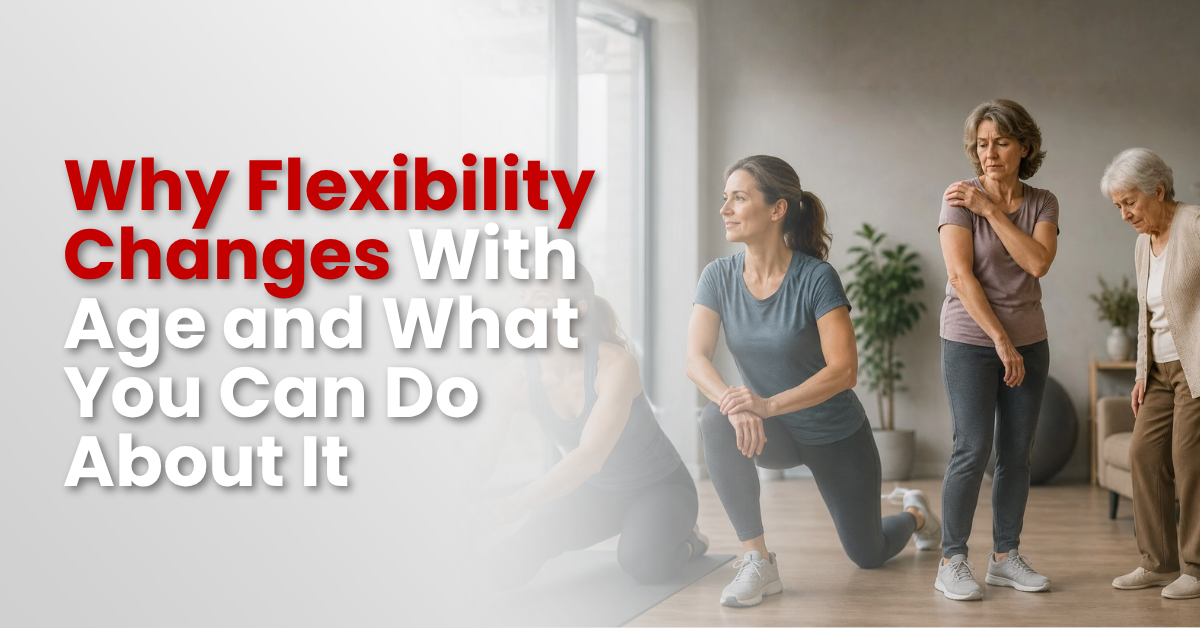
Bending down to tie your shoes, checking your blind spot, reaching the top shelf. Movements that once required no thought can start to feel noticeably tighter somewhere in your 40s, 50s or 60s.
Some of that change is a normal part of ageing. But a surprising amount of it isn’t ageing at all, it’s the result of moving less, and less variously, than we used to. That distinction matters, because the part driven by inactivity responds well to doing something about it, at any age.
Here’s what’s actually happening, and what the evidence says you can do.
What Causes Loss of Flexibility With Age?
Several changes in the body contribute to that gradually stiffer feeling:
- Connective tissue changes: Collagen, the main protein in tendons, ligaments and joint capsules, becomes stiffer and less elastic over time
- Tissue hydration decreases: Cartilage, discs and other tissues hold less water with age, reducing their give
- Muscle changes: From roughly our 30s onward we gradually lose muscle mass and elasticity unless we actively work to maintain it
- Joint changes: Wear in joint surfaces can subtly reduce comfortable range of motion
None of this means stiffness is inevitable or untreatable. It means the margin for inactivity shrinks, and the body increasingly keeps only the movement it regularly uses.
The Bigger Culprit: Moving Less, and Less Variously
Children squat, climb, reach and twist through a huge range of movement every day. Most adult life, by contrast, cycles between sitting, standing and walking, with the occasional reach thrown in.
Joints and muscles adapt to the demands placed on them. Ranges of motion you rarely visit gradually become ranges you can’t comfortably visit. That’s why people often notice big differences between areas of their own body hips and upper back stiffen for desk workers, shoulders stay mobile in swimmers, and a lifelong gardener may squat comfortably at 70.
The practical upside: because much of age-related stiffness is driven by disuse rather than ageing itself, it’s more changeable than most people assume.
Building variety into your movement routine can help you stay active without injury and continue using a wider range of movement as you age.
Why Flexibility Is Worth Maintaining
Flexibility isn’t about touching your toes for its own sake. Comfortable range of motion supports:
- Everyday function: Dressing, driving, gardening, playing with kids or grandkids
- Balance and confidence: Mobile ankles, hips and spine contribute to steadiness on your feet
- Quality of movement: Restricted joints force other areas to compensate, which can place extra load on surrounding tissues
- Staying active: Maintaining the mobility to keep doing the activities you enjoy is what protects strength, fitness and independence in the long run
What You Can Do About It
The evidence here is genuinely encouraging: exercise guidelines for adults, including older adults, consistently recommend regular flexibility and mobility work, and research shows range of motion remains trainable throughout life.
Move Through Your Full Range, Regularly
The single most important habit is regularly visiting the ranges you want to keep. Squat down to the garden bed rather than bending at the waist, reach fully overhead, look over both shoulders. Frequency beats intensity.
Stretch Consistently, Not Occasionally
Regular stretching improves range of motion over time. Guidelines suggest stretching major muscle groups at least two to three times per week, holding each stretch to the point of gentle tension, not pain. A sustainable ten minutes most days does more than a long session once a fortnight.
Strength Training Counts Too
One of the more useful research findings of recent years: strength training performed through a full range of motion can improve flexibility comparably to stretching, while also building the muscle that naturally declines with age. Two benefits, one activity.
Consider Structured Movement Like Pilates
Practices that combine mobility, strength and control, such as Clinical Pilates, work multiple ingredients at once. Clinical Pilates adds professional supervision, which is useful if you’re managing an injury, stiffness in a specific area, or you’re returning to exercise after a long break.
Start Where You Are
It’s never too late to begin. Position statements on exercise for older adults are clear that people benefit from starting flexibility and strength work at any age, and programs can be adapted to any starting point. The comparison that matters is with your own body last month, not with your 25-year-old self.
When Stiffness Deserves an Assessment
General, even stiffness that eases with movement is usually the trainable kind. It’s worth getting assessed when:
- Stiffness is concentrated in one joint or one side of the body
- It comes with pain, swelling, clicking or catching
- A joint has noticeably lost range quickly, over weeks rather than years
- Stiffness is limiting activities you want or need to do
- Morning stiffness regularly lasts longer than 30 minutes, which is worth discussing with your GP, as it can occasionally indicate an inflammatory condition
One-sided or painful stiffness often has a specific, treatable driver, and that’s worth finding rather than stretching at blindly.
How Professional Support Can Help
- Physiotherapy: Assesses which joints and tissues are restricting you and builds a targeted mobility and strength program
- Chiropractic care: Assesses joint mobility through the spine and limbs that may be contributing to stiffness
- Remedial massage: May help ease muscle tension that limits comfortable movement
- Clinical Pilates: Develops mobility, strength and control together, with exercises scaled to your level
- Dry needling: May assist with tight, overactive muscles that restrict range
The right starting point depends on your age, history and goals, which is why an individual assessment comes first.
Keep Moving Well With Next Phase Injury Therapy
At Next Phase Injury Therapy in Yagoona, our physiotherapists, chiropractors, remedial massage therapists and Pilates instructors work with people at every age and stage, from those noticing their first stiff mornings to those working to stay independent and active in later life.
We work with you to:
- Identify what’s actually restricting your movement
- Build a realistic mobility and strength routine you can maintain
- Adapt the plan as your body changes, so you keep the ranges that matter to you
Stiffer Than You’d Like to Be?
Flexibility responds to attention at any age, and the best time to start is while the change is still small.
Explore our physiotherapy, chiropractic, remedial massage and clinical Pilates services, or book an appointment with Next Phase Injury Therapy. We’re open 8am to 8pm, seven days a week. Yes, even Sundays.
FAQs
1. Why does flexibility decrease with age?
Loss of flexibility with age can happen for several reasons, including changes in connective tissue, reduced muscle mass and elasticity, changes in joint structures, and simply moving through a smaller range of motion. While some changes are a normal part of ageing, inactivity can contribute significantly to stiffness and reduced flexibility.
2. Can you improve flexibility as you get older?
Yes. Flexibility remains trainable throughout life. Regular stretching, mobility exercises and strength training performed through a comfortable full range of motion can help improve or maintain flexibility at any age. The key is consistency rather than trying to make large changes quickly.
3. What exercises can help with loss of flexibility with age?
Exercises that regularly move your joints through their comfortable range of motion can help. Stretching, mobility exercises, strength training and activities such as Clinical Pilates can all contribute to maintaining flexibility. The right exercises depend on your current mobility, physical condition and goals.
4. When should I see a physiotherapist about stiffness or reduced flexibility?
Consider an assessment if stiffness is concentrated in one joint or one side of the body, occurs with pain or swelling, develops quickly, or starts limiting everyday activities. Persistent morning stiffness lasting more than 30 minutes is also worth discussing with your GP. A physiotherapist can assess what may be restricting your movement and develop an individualised mobility and strengthening program.
References
- Garber, Carol Ewing, et al. “Quantity and Quality of Exercise for Developing and Maintaining Cardiorespiratory, Musculoskeletal, and Neuromotor Fitness in Apparently Healthy Adults: Guidance for Prescribing Exercise.” Medicine & Science in Sports & Exercise, vol. 43, no. 7, 2011, pp. 1334–1359, https://doi.org/10.1249/MSS.0b013e318213fefb.
- Chodzko-Zajko, Wojtek J., et al. “Exercise and Physical Activity for Older Adults.” Medicine & Science in Sports & Exercise, vol. 41, no. 7, 2009, pp. 1510–1530, https://doi.org/10.1249/MSS.0b013e3181a0c95c.
- Afonso, José, et al. “Strength Training versus Stretching for Improving Range of Motion: A Systematic Review and Meta-Analysis.” Healthcare, vol. 9, no. 4, 2021, p. 427, https://doi.org/10.3390/healthcare9040427.
- Behm, David G., et al. “Acute Effects of Muscle Stretching on Physical Performance, Range of Motion, and Injury Incidence in Healthy Active Individuals: A Systematic Review.” Applied Physiology, Nutrition, and Metabolism, vol. 41, no. 1, 2016, pp. 1–11, https://doi.org/10.1139/apnm-2015-0235.
- Stathokostas, Liza, et al. “Flexibility Training and Functional Ability in Older Adults: A Systematic Review.” Journal of Aging Research, vol. 2012, 2012, article 306818, https://doi.org/10.1155/2012/306818.
- Fragala, Maren S., et al. “Resistance Training for Older Adults: Position Statement from the National Strength and Conditioning Association.” Journal of Strength and Conditioning Research, vol. 33, no. 8, 2019, pp. 2019–2052, https://doi.org/10.1519/JSC.0000000000003230.
Information on this page is general in nature and is not a substitute for individualised advice from a registered health practitioner. Our practitioners are registered with AHPRA.