
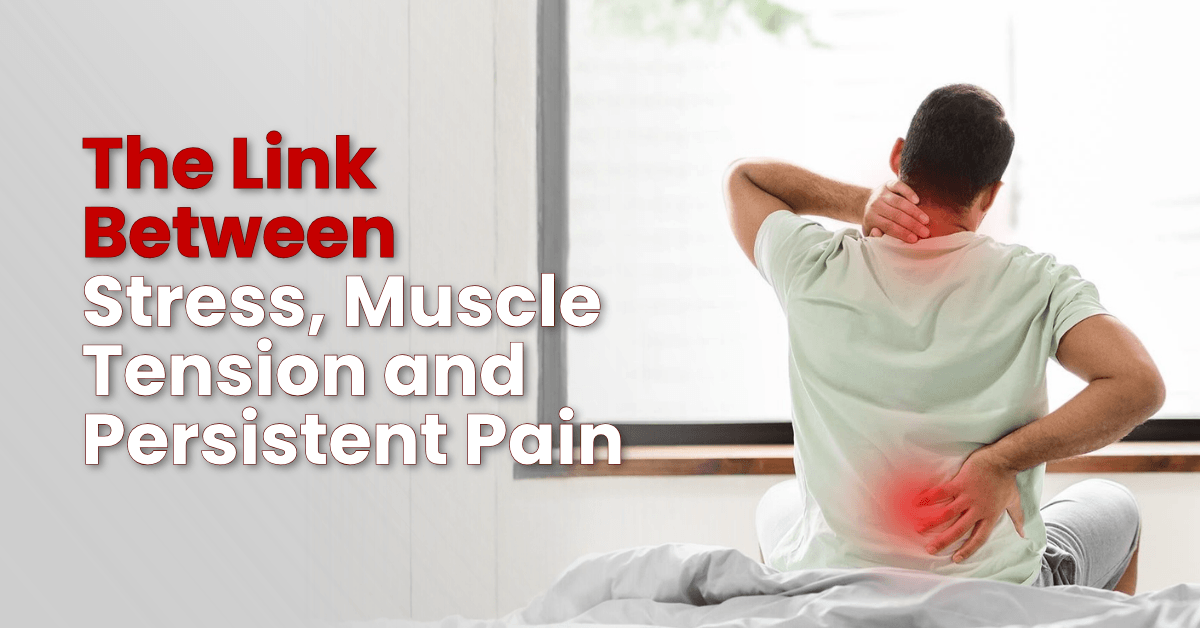
Most people have felt it: a brutal week at work, and by Friday your shoulders are up around your ears and your neck has a familiar ache. Stress doesn’t stay in your head. It shows up in your body, and for some people it becomes part of why pain persists long after it should have settled.
One thing to be clear about from the start, because this topic is often misunderstood: pain influenced by stress is not imaginary pain. It’s real pain, produced by a real nervous system doing what nervous systems do. Understanding the link doesn’t diminish your pain, it gives you more ways to address it.
Here’s how the cycle works, and how to interrupt it.
How Stress Shows Up in Your Muscles
When your body reads a situation as demanding, it prepares for action: muscles subtly increase their resting tension, ready to move. That’s useful for a sprint. It’s less useful sustained across a nine-hour workday, week after week.
The areas that hold this low-level tension are familiar to anyone who’s had a stressful season: the jaw, the neck, the shoulders and upper back, sometimes the lower back. Muscles working a constant low-grade shift become tender, tight and fatigued, which is a genuine, physical source of discomfort, not a metaphorical one.
How Stress Turns Up the Pain System Itself
The second part of the link is less visible and more important. Modern pain science has established that pain isn’t a simple damage meter. It’s produced by the nervous system weighing many inputs, what’s happening in the tissues, yes, but also your stress levels, sleep, past experiences and what the pain means to you.
Under sustained stress, the nervous system tends to become more protective, more easily triggered, more insistent. The same signal from the same tissue can produce more pain in a stressed, exhausted system than in a rested one. If you’ve noticed your old injury flares during hard life periods, this is a large part of why.
Research bears this out clinically: psychological factors like stress and low mood are consistently associated with how musculoskeletal pain progresses and how well people recover.
The Cycle That Keeps Pain Going
Put the pieces together and a loop emerges:
- Stress increases muscle tension and turns up nervous system protectiveness
- Pain increases, or persists past normal healing time
- Pain itself becomes a stressor, disrupting sleep, limiting activity, generating worry
- Worry about pain leads to avoiding movement, and researchers have documented how this fear-avoidance pattern leads to deconditioning and more pain
- Return to step one, now with less fitness and worse sleep
None of this involves imaginary pain or personal weakness. It’s a well-documented pattern in an ordinary nervous system, and each step in the loop is a place you can intervene.
How to Interrupt the Cycle
Keep Moving, Gently and Consistently
Exercise is the rare intervention that works on both ends of the loop at once: it maintains the body’s condition and it’s one of the best-supported stress regulators there is. It doesn’t need to be heroic, walks, swimming, stretching, whatever your current state allows, done regularly.
Protect Your Sleep
Sleep is where both a stressed system and sore tissues recover, and it’s usually the first casualty of the cycle. Treat a consistent wind-down and seven to nine hours as part of your pain management, not a luxury.
Give the Tension Somewhere to Go
Deliberate downshifting, slow breathing, stretching, a bath, time outdoors, quiet time away from screens, gives chronically braced muscles genuine off-duty time. Hands-on treatment like remedial massage may help ease built-up muscle tension too, and many people find the short-term relief creates room to get moving again.
Understand Your Pain
It sounds too simple, but research on pain education shows that understanding how pain actually works, that hurt doesn’t always equal harm, that systems can be sensitised, can itself reduce the threat pain carries, and with it, some of its grip.
Deal With the Stress Load Itself
Sometimes the most effective pain intervention isn’t physical at all: renegotiating an unsustainable workload, asking for help, addressing the thing you’ve been carrying. And if stress, worry or low mood have become significant in their own right, your GP or a psychologist is the right professional for that side, it pairs with physical care, and neither replaces the other.
When to Get Professional Support
It’s worth an assessment if:
- Pain has persisted beyond normal healing time and flares with stressful periods
- Muscle tension in the neck, shoulders or jaw has become a constant companion
- You’ve started avoiding movement or activities because of pain
- You want a plan that addresses your whole situation, not just the sore spot
See your GP if pain comes with the red flags we’ve covered in other articles, or if stress and mood themselves feel like they need support, both are ordinary, sensible reasons to seek help.
Whole-Person Care at Next Phase Injury Therapy
At Next Phase Injury Therapy in Yagoona, our physiotherapists, chiropractors and remedial massage therapists work from the understanding this article describes: persistent pain usually has more than one input, and good care addresses the ones within reach.
We work with you to:
- Assess the physical contributors, tension, deconditioning, movement patterns, honestly
- Build a graded movement plan that rebuilds your body’s tolerance and confidence
- Ease the muscular side of the load while you address the rest, and point you toward the right support for anything beyond our lane
Ready to Break the Cycle?
If tension and pain have been feeding each other for months, the loop won’t untangle itself, but it will respond to a plan.
Explore our physiotherapy, chiropractic, remedial massage and clinical Pilates services, or book an appointment with Next Phase Injury Therapy. We’re open 8am to 8pm, seven days a week. Yes, even Sundays.
References
- Moseley, G. Lorimer, and David S. Butler. “Fifteen Years of Explaining Pain: The Past, Present, and Future.” The Journal of Pain, vol. 16, no. 9, 2015, pp. 807–813, https://doi.org/10.1016/j.jpain.2015.05.005.
- Vlaeyen, Johan W. S., and Steven J. Linton. “Fear-Avoidance and Its Consequences in Chronic Musculoskeletal Pain: A State of the Art.” Pain, vol. 85, no. 3, 2000, pp. 317–332, https://doi.org/10.1016/S0304-3959(99)00242-0.
- Foster, Nadine E., et al. “Prevention and Treatment of Low Back Pain: Evidence, Challenges, and Promising Directions.” The Lancet, vol. 391, no. 10137, 2018, pp. 2368–2383, https://doi.org/10.1016/S0140-6736(18)30489-3.
- O’Sullivan, Peter B., et al. “Cognitive Functional Therapy: An Integrated Behavioral Approach for the Targeted Management of Disabling Low Back Pain.” Physical Therapy, vol. 98, no. 5, 2018, pp. 408–423, https://doi.org/10.1093/ptj/pzy022.
- Chester, Rachel, et al. “Psychological Factors Are Associated with the Outcome of Physiotherapy for People with Shoulder Pain: A Multicentre Longitudinal Cohort Study.” British Journal of Sports Medicine, vol. 52, no. 4, 2018, pp. 269–275, https://doi.org/10.1136/bjsports-2016-096084.
Information on this page is general in nature and is not a substitute for individualised advice from a registered health practitioner. Our practitioners are registered with AHPRA.


