
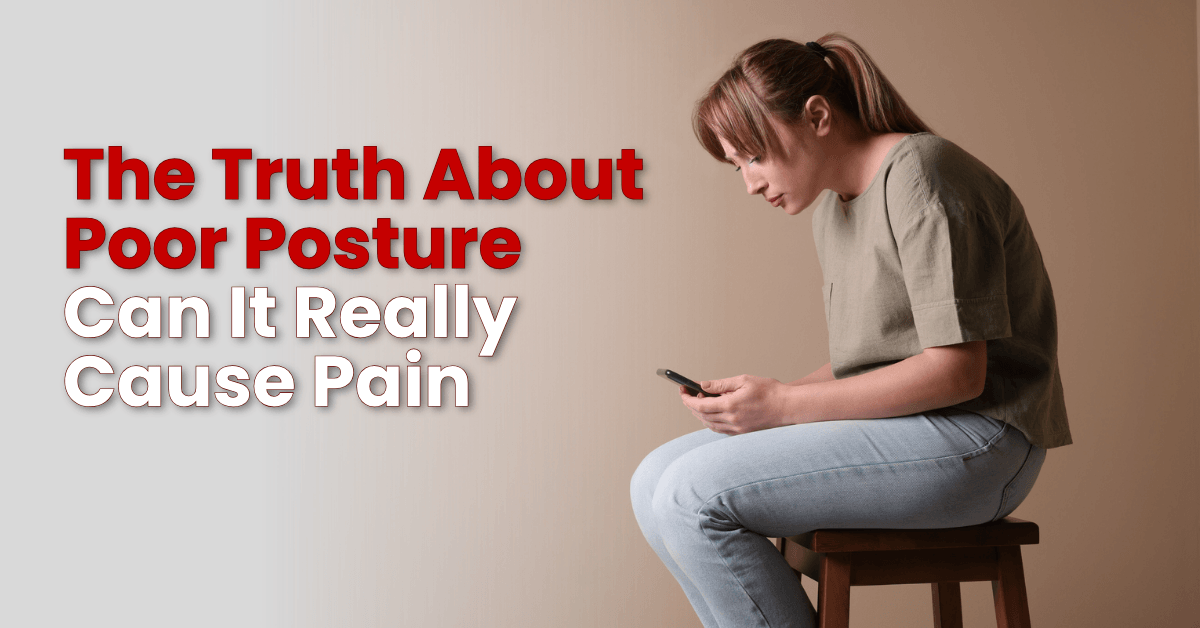
Poor posture gets blamed for a lot. Back pain, neck pain, headaches, shoulder tension, fatigue. The advice follows quickly: sit up straight, stop slouching, get a better chair. Posture correction is a whole industry.
The honest answer is more complicated than that, and more useful. The relationship between posture and pain is real, but it’s not the simple cause-and-effect most people assume. Understanding what’s actually going on can save you years of guilt about how you sit and point you toward what genuinely helps.
What Does the Research Actually Say?
Here’s where the evidence surprises most people. Reviews examining whether specific postures reliably cause pain, including systematic reviews of sitting posture and low back pain, and forward head posture and neck pain, have not found consistent evidence that posture alone causes pain.
Plenty of people with textbook posture have significant pain. Plenty of people who slouch their way through the day have none. The relationship isn’t that direct.
That doesn’t mean posture is irrelevant. It means the story is more nuanced than “bad posture equals pain.”
What Posture Actually Is
Posture is simply how the body holds itself in space, statically and dynamically. There is no single correct posture, and trying to hold a “perfect” position rigidly often creates its own tension and discomfort.
What does matter:
- Variety: The body handles positions well and sustained sameness poorly. Any position held without change for long enough becomes uncomfortable, in a well-aligned person as much as anyone else
- Load distribution: Some positions place higher demand on specific structures than others, and if those structures are already under load or not well conditioned, pain can develop
- Movement habits: How you move repeatedly, not just how you sit, shapes what tissues experience day after day
When Posture Does Contribute to Pain
Posture isn’t irrelevant, it’s just not the whole story. There are situations where postural patterns genuinely contribute to pain:
- Sustained positions over long periods: Hours in one position, whether sitting at a desk, standing on a worksite or looking down at a phone, reduce movement variety and concentrate load on the same structures
- Positions that load already-sensitised tissue: If a muscle or joint is already under stress, sustained positions that keep it in that state can maintain or worsen pain
- Compensations from injury or weakness: When one area isn’t working well, the body shifts its postural strategy, and those compensations can load other areas over time
The common thread is not the position itself but how long it’s held, how often it’s repeated, and what state the tissues are already in.
What Are the Symptoms of Poor Posture Pain?
Posture-related pain symptoms are not unique to posture — the same symptoms have many potential causes. Common presentations that people attribute to posture include:
- Neck pain and stiffness, particularly after long periods at a desk or screen
- Upper back and shoulder tension, building through the day and easing with movement
- Lower back aching after prolonged sitting or standing
- Headaches originating from the neck and upper back
- Jaw tension, often associated with sustained forward head positions
These symptoms are real and worth addressing. The important point is that addressing them means looking at the whole picture, load, movement habits, strength and lifestyle, not just the position.
What Areas of the Body Can Posture Affect?
Postural habits and sustained positions most commonly contribute to symptoms in:
- The neck and upper back, which carry the head and arms through long working days
- The lower back, particularly with prolonged sitting or standing without variety
- The shoulders, especially with sustained desk work or repetitive overhead demands
- The hips, which adapt to extended sitting by shortening the muscles at the front
These aren’t isolated to posture, they’re the areas most commonly affected by movement deficits and load imbalances, which posture can contribute to but doesn’t solely determine.
What Are the Long-Term Effects of Bad Posture?
This question is worth answering carefully. The evidence doesn’t support the idea that “bad posture” reliably leads to specific structural damage over time. Spinal changes that appear on scans are common in pain-free people across all ages and body types.
What is supported by evidence: long-term inactivity, reduced movement variety and deconditioning, which often accompany poor postural habits, are associated with increased musculoskeletal pain and reduced function over time. The problem is less the position and more what accompanies it, stillness, narrowed movement, weakened muscles.
What Are the Common Signs of Poor Posture?
Signs people commonly associate with poor posture include:
- Rounded shoulders or a head that sits forward of the shoulders
- Increased curve in the upper back (thoracic kyphosis)
- Flattened or exaggerated lower back curve
- One shoulder sitting higher than the other
- Difficulty standing fully upright after prolonged sitting
These observations are worth noting, but they describe a postural pattern rather than a diagnosis. Many people with these features have no pain, and many people without them do. Assessment matters more than the visual snapshot.
Can Physiotherapy and Chiropractic Care Help?
Yes, but the most effective approach addresses more than posture correction alone.
Physiotherapy for posture-related pain focuses on identifying which muscles and movement patterns are contributing to your symptoms, building strength in areas that are underloaded, and improving the variety and quality of your movement overall.
Chiropractic care for posture-related pain assesses joint mobility through the spine and surrounding areas, and uses manual therapy alongside movement advice to restore comfortable range and reduce load on sensitised structures.
At a multidisciplinary clinic, both approaches can work together where that’s the most effective path.
Posture and Pain Assessment at Next Phase Injury Therapy
At Next Phase Injury Therapy in Yagoona, posture is one part of a thorough movement assessment, not the whole story. Our physiotherapists and chiropractors look at how you move, what demands your day places on your body and where the actual drivers of your pain are.
We work with you to:
- Assess your movement patterns and identify what’s actually contributing to your symptoms
- Build strength and movement variety in the areas that need it
- Make practical changes to your daily habits that reduce load on sensitised tissues
Ready to Find Out What’s Actually Going On?
If neck pain, back pain or shoulder tension has been following you through the workday, the answer is rarely “just sit up straighter.”
Explore our physiotherapy, chiropractic and remedial massage services, or book an appointment with Next Phase Injury Therapy in Yagoona. We’re open 8am to 8pm, seven days a week. Yes, even Sundays.
Frequently Asked Questions
Can poor posture really cause pain?
Not in the simple cause-and-effect way most people assume. Research hasn’t found consistent evidence that specific postures reliably cause pain. What matters more is movement variety, load distribution and the state of the tissue, posture can contribute to those, but it’s rarely the sole driver.
What are the symptoms of poor posture pain?
Common symptoms attributed to posture include neck pain and stiffness, upper back and shoulder tension, lower back aching after prolonged sitting, and headaches from the neck and upper back. These symptoms have many potential causes and are best assessed in context rather than attributed to posture alone.
What are the long-term effects of bad posture?
The evidence doesn’t support the idea that poor posture causes specific structural damage over time. What’s better supported is that the inactivity, reduced movement variety and deconditioning that often accompany poor postural habits are associated with increased pain and reduced function over time.
What areas of the body can poor posture affect?
The neck, upper back, shoulders, lower back and hips are the areas most commonly affected by sustained positions and movement deficits, which postural habits can contribute to alongside other factors.
What are the common signs of poor posture?
Rounded shoulders, a forward head position, an increased upper back curve, uneven shoulder height and difficulty standing upright after prolonged sitting are commonly noted. These describe a pattern rather than a diagnosis and are most useful as part of a full movement assessment.
Can physiotherapy help with poor posture pain?
Yes. Physiotherapy identifies which muscles and movement patterns are contributing to your symptoms and builds a program to address them through strength work, movement variety and practical habit changes. Chiropractic care can also help by restoring joint mobility and reducing load on sensitised structures.
References
- Slater, Daniel, et al. “Sit Up Straight: Time to Re-evaluate.” Journal of Orthopaedic and Sports Physical Therapy, vol. 49, no. 8, 2019, pp. 562–564, https://doi.org/10.2519/jospt.2019.0610.
- Christensen, Stine Thomsen, and Jan Hartvigsen. “Spinal Curves and Health: A Systematic Critical Review of the Epidemiological Literature Dealing with Associations between Sagittal Spinal Curves and Health.” Journal of Manipulative and Physiological Therapeutics, vol. 31, no. 9, 2008, pp. 690–714, https://doi.org/10.1016/j.jmpt.2008.10.004.
- Dolphens, Mieke, et al. “Sagittal Standing Posture and Its Association with Spinal Pain: A School-Based Epidemiological Study of 1196 Flemish Adolescents before Age at Peak Height Velocity.” Spine, vol. 37, no. 21, 2012, pp. 1657–1666, https://doi.org/10.1097/BRS.0b013e31825fa373.
- Brinjikji, Waleed, et al. “Systematic Literature Review of Imaging Features of Spinal Degeneration in Asymptomatic Populations.” American Journal of Neuroradiology, vol. 36, no. 4, 2015, pp. 811–816, https://doi.org/10.3174/ajnr.A4173.
- Lin, Ivan, et al. “What Does Best Practice Care for Musculoskeletal Pain Look Like? Eleven Consistent Recommendations from High-Quality Clinical Practice Guidelines: Systematic Review.” British Journal of Sports Medicine, vol. 54, no. 2, 2020, pp. 79–86, https://doi.org/10.1136/bjsports-2018-099878.
- Roffey, Darren M., et al. “Causal Assessment of Occupational Sitting and Low Back Pain: Results of a Systematic Review.” The Spine Journal, vol. 10, no. 3, 2010, pp. 252–261, https://doi.org/10.1016/j.spinee.2009.12.005.
Information on this page is general in nature and is not a substitute for individualised advice from a registered health practitioner. Our practitioners are registered with AHPRA.


