
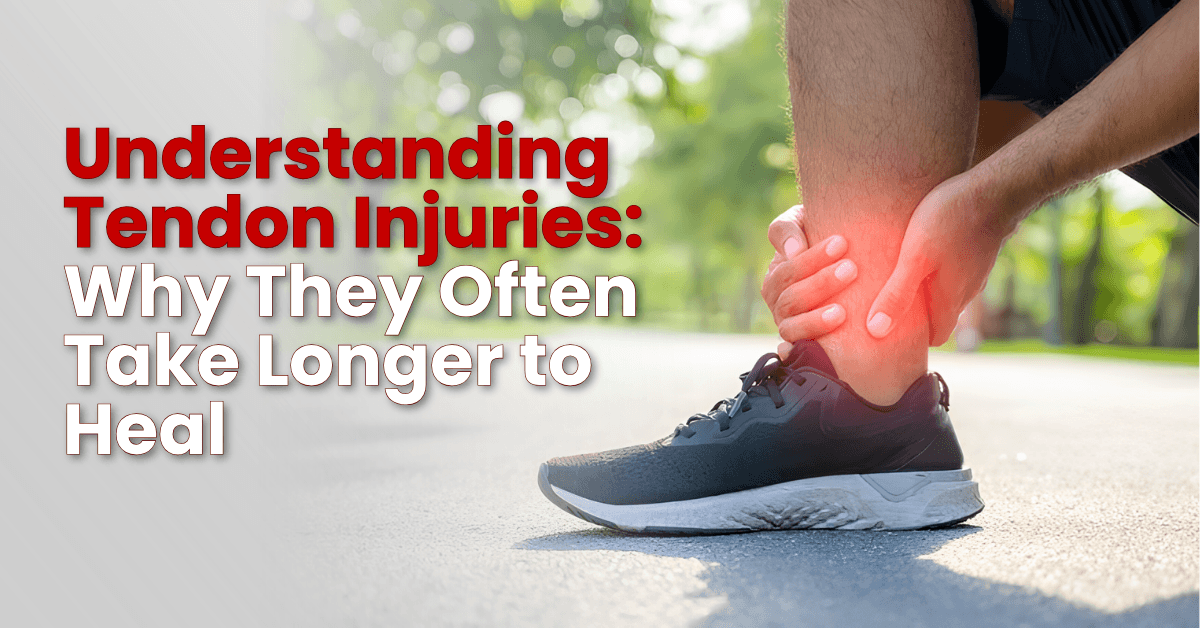
Tendon injuries can be frustrating. One week your Achilles, shoulder, elbow or knee tendon feels slightly irritated. The next, it hurts every time you run, lift, grip, jump or walk downstairs.
The hardest part is often the timeline. Muscle soreness may settle in days, but tendon pain can hang around for weeks or months if it is not managed properly. That does not mean the tendon is broken forever. It usually means the tendon needs the right balance of load, recovery and progressive strengthening.
Here is what tendon injury recovery usually involves, why tendon injuries often take longer to heal, and how physiotherapy for tendon injury can help guide the process.
What Is a Tendon Injury?
Tendons are strong connective tissues that attach muscles to bones. They help transfer force when you move, lift, jump, run, grip or push.
A tendon injury can include:
- Tendinopathy, where the tendon becomes painful and less tolerant of load over time
- Tendon irritation or overload, often from doing too much too soon
- Partial tendon tears, where some fibres are disrupted
- Complete tendon tears or ruptures, where the tendon is fully torn and may need urgent medical or surgical assessment
Common tendon problems include Achilles tendinopathy, patellar tendinopathy, rotator cuff tendon pain, tennis elbow, golfer’s elbow and gluteal tendinopathy.
Why Do Tendon Injuries Take Longer to Heal?
Tendon injuries often take longer to heal because tendons adapt slowly.
Compared with muscles, tendons generally have a lower blood supply and respond more gradually to training load. They are built to tolerate force, but they do not love sudden spikes. A new running program, heavier gym work, more jumping, extra manual labour, or returning to sport too quickly can all overload a tendon before it has adapted.
Another reason tendon recovery can be slow is that pain is not the only marker of healing. A tendon may feel better after rest, but that does not always mean it is ready for full load again. If you go straight back to the same activity that caused the problem, symptoms often return.
That is why tendon injury rehabilitation usually focuses on rebuilding capacity, not simply resting until pain disappears.
How Long Do Tendons Take to Heal?
Tendon healing time varies depending on the tendon involved, the severity of the injury, your activity level and how long symptoms have been present.
As a general guide:
- Mild tendon irritation: May improve over a few weeks with load management and the right exercises
- Persistent tendinopathy: Often takes 6 to 12 weeks or longer of consistent rehabilitation
- Chronic tendon pain: May take several months, especially if symptoms have been present for a long time
- Partial or complete tendon tear: Torn tendon recovery time varies widely and may require imaging, specialist input or surgery
If you are wondering how long tendons and ligaments take to heal, the honest answer is that both can be slow. Ligaments and tendons are different structures, but both often need gradual loading, time and good rehab to restore strength and confidence.
Tendinopathy vs Torn Tendon: Why the Difference Matters
Not all tendon pain means the tendon is torn.
Tendinopathy is usually a load-related tendon problem. It often builds gradually and may feel stiff, sore or weak during specific activities. It can be painful, but it does not always mean there is a major tear.
A torn tendon is different. A significant tendon tear may involve:
- A sudden sharp pain
- A popping or snapping feeling
- Immediate weakness
- Difficulty lifting, pushing off, gripping or bearing weight
- Visible bruising or a change in muscle shape
- Loss of function compared with the other side
If you are searching for how to heal a torn tendon, it is important to get assessed first. Some tears can be managed with rehabilitation, while others may need imaging or specialist review. Trying to “push through” a suspected tear can make recovery more complicated.
What Does Tendon Healing Feel Like?
Tendon healing is rarely a perfectly straight line.
As the tendon starts tolerating load again, you may notice:
- Less morning stiffness
- Pain that settles more quickly after activity
- Better strength during daily tasks
- Improved confidence with stairs, running, lifting or gripping
- Fewer flare-ups after training or work
- More predictable symptoms from week to week
Some discomfort during tendon rehab can be normal, depending on the injury and exercise plan. The key is how the tendon responds afterwards. If pain settles within a reasonable timeframe and function is improving, the load may be appropriate. If pain keeps building, lingers strongly into the next day, or your function drops, the plan likely needs adjusting.
The Stages of Healing Tendinopathy
Tendon problems are often discussed in stages, but it helps to separate acute tendon healing from tendinopathy.
For an acute tendon injury or tear, healing is often described in broad biological phases:
1. Inflammation
This is the early stage after injury. Pain, swelling and sensitivity may be higher, and the goal is usually to protect the area while keeping safe movement where appropriate.
2. Proliferation
The body starts laying down new tissue. The tendon may still feel weak or sensitive, so loading needs to be controlled and gradual.
3. Remodelling
The tendon tissue gradually becomes more organised and better able to tolerate force. This stage can take months, especially for higher-load tendons like the Achilles.
For tendinopathy, clinicians may also describe a continuum from reactive tendinopathy through to tendon disrepair or degenerative tendinopathy. In real life, the main message is simple: the longer a tendon has been overloaded, the more carefully the rehab plan usually needs to be progressed.
Achilles Tendon Healing Stages: A Common Example
The Achilles tendon is a good example because it deals with high forces during walking, running, jumping and sport.
Early Achilles tendon pain may feel like stiffness first thing in the morning or soreness at the start of a run that “warms up.” As it becomes more irritated, pain may last longer, affect walking, or flare after activity.
Achilles tendon healing stages often involve:
- Reducing the most aggravating loads
- Restoring comfortable walking and calf function
- Building calf strength with progressive loading
- Reintroducing running, hopping and sport-specific work where relevant
- Monitoring next-day pain and stiffness as load increases
The aim is not to avoid loading forever. The aim is to load the tendon at a level it can adapt to.
Can You Accelerate Tendon Healing?
You cannot force a tendon to heal overnight. Claims about how to accelerate tendon healing should be treated carefully.
What you can do is create better conditions for recovery:
- Reduce the activities that repeatedly flare the tendon
- Keep moving in ways the tendon can tolerate
- Build strength with a progressive loading plan
- Avoid sudden spikes in running, jumping, lifting or gripping
- Prioritise sleep and general recovery
- Eat enough protein and overall energy to support tissue repair
- Get guidance if symptoms keep returning
The fastest path is usually not the most aggressive one. It is the most consistent one.
How Physiotherapy Can Help Tendon Injury Recovery
Physiotherapy for tendon injury is usually about matching load to the tendon’s current capacity, then building from there.
At Next Phase Injury Therapy, tendon injury treatment in Yagoona may include:
- Assessment of pain, strength, mobility and function
- Identifying the activities or training loads that are driving symptoms
- A staged tendon injury rehabilitation plan
- Progressive strengthening for the affected tendon and surrounding muscles
- Advice on modifying sport, gym, work or daily activities
- Return-to-sport or return-to-work progressions where relevant
- Hands-on treatment where appropriate to help support movement and comfort
For tendinopathy treatment, the exercise plan matters. Too much load can flare the tendon. Too little load may not create enough adaptation. The right level sits between those two.
When to Get a Tendon Injury Assessed
It is worth booking an assessment if:
- Tendon pain has lasted more than a couple of weeks
- Pain returns every time you run, lift, grip or jump
- Morning stiffness is becoming more noticeable
- You feel weak, unstable or unable to trust the area
- Symptoms improve with rest but return as soon as activity resumes
- You are unsure whether it is tendinopathy or a tear
- You are preparing to return to sport after tendon pain
Seek prompt medical care if there was a sudden pop, major bruising, visible deformity, severe weakness, inability to bear weight, or loss of normal function.
Tendon Injury Treatment at Next Phase Injury Therapy
At Next Phase Injury Therapy in Yagoona, our team supports people with tendon pain, sports injuries, muscle and joint pain, and injury rehabilitation.
We work with you to:
- Understand what is contributing to your tendon pain
- Reduce aggravating load where appropriate
- Build a progressive strengthening plan
- Support tendon pain treatment with education and movement strategies
- Guide your return to work, gym, running or sport
If you are looking for tendon injury treatment in Yagoona, sports injury treatment, sports injury rehabilitation, pain relief support or physiotherapy in Yagoona, our team can help assess where you are now and what the next step should look like.
Explore our physiotherapy, chiropractic and remedial massage services, or book an appointment with Next Phase Injury Therapy. We are located at 444 Hume Highway, Yagoona NSW 2199, and open 8am to 8pm, seven days a week.
Frequently Asked Questions About Tendon Injury Recovery
Why do tendon injuries take longer to heal?
Tendons usually adapt more slowly than muscles and can become sensitive when load increases too quickly. Recovery often depends on gradually rebuilding the tendon’s capacity, not just waiting for pain to settle.
How long does a tendon injury take to heal?
Mild tendon irritation may improve within a few weeks, while persistent tendinopathy often takes 6 to 12 weeks or longer. More severe or torn tendon injuries can take several months and may need imaging or specialist input.
What does tendon healing feel like?
Tendon healing may feel like less morning stiffness, fewer flare-ups, better strength, and pain that settles more quickly after activity. Progress is often gradual rather than immediate.
What are the stages of healing tendinopathy?
Tendinopathy is often described as moving through stages such as reactive tendinopathy, tendon disrepair and degenerative tendinopathy. Acute tendon healing is also commonly described through inflammation, proliferation and remodelling phases.
Can you accelerate tendon healing?
You cannot force a tendon to heal instantly, but you can support recovery by managing load, doing appropriate strengthening, avoiding repeated flare-ups, and getting guidance if symptoms persist.
Can physiotherapy help with tendon injury recovery?
Physiotherapy may help by assessing the tendon’s current capacity, guiding progressive loading, improving strength and mobility, and supporting a gradual return to work, sport or daily activity.
This article provides general information only and is not a substitute for individual clinical assessment or medical advice. Tendon injuries vary widely, and recovery times depend on the tendon involved, severity, symptoms and activity demands. If you suspect a tendon tear or symptoms are not improving, speak with a qualified health practitioner.
References
- Chartier, C., et al. “Tendon: Principles of Healing and Repair.” Seminars in Plastic Surgery, 2021. https://pmc.ncbi.nlm.nih.gov/articles/PMC8432990/
- Silbernagel, K. G., et al. “Conservative Management of Achilles Tendinopathy.” Journal of Athletic Training, 2020. https://pmc.ncbi.nlm.nih.gov/articles/PMC7249277/
- Rosen, A. B., et al. “Clinical Management of Patellar Tendinopathy.” Journal of Athletic Training, 2021. https://pmc.ncbi.nlm.nih.gov/articles/PMC9528703/
- Cook, J. L., et al. “Revisiting the Continuum Model of Tendon Pathology: What Is Its Merit in Clinical Practice and Research?” British Journal of Sports Medicine, 2016. https://pmc.ncbi.nlm.nih.gov/articles/PMC5118437/
- Escriche-Escuder, A., et al. “Progression Criteria in Loading Exercise Programmes in Lower Limb Tendinopathy: A Systematic Review.” BMJ Open Sport & Exercise Medicine, 2019. https://pmc.ncbi.nlm.nih.gov/articles/PMC6924812/
Information on this page is general in nature and is not a substitute for individualised advice from a registered health practitioner. Our practitioners are registered with AHPRA.


