Chronic tendon pain is stubborn by nature. An Achilles that’s ached for a year, a heel that hurts with every morning’s first steps, a shoulder that’s grumbled through months of exercises. When a tendon problem has outlasted the usual approaches, people often start hearing about shockwave therapy and wondering whether it’s worth trying.
The honest answer: shockwave therapy has a legitimate place in managing chronic tendon pain, but it’s a specific tool for specific situations, not a first stop or a standalone fix. Here’s where it fits.
What Is Shockwave Therapy?
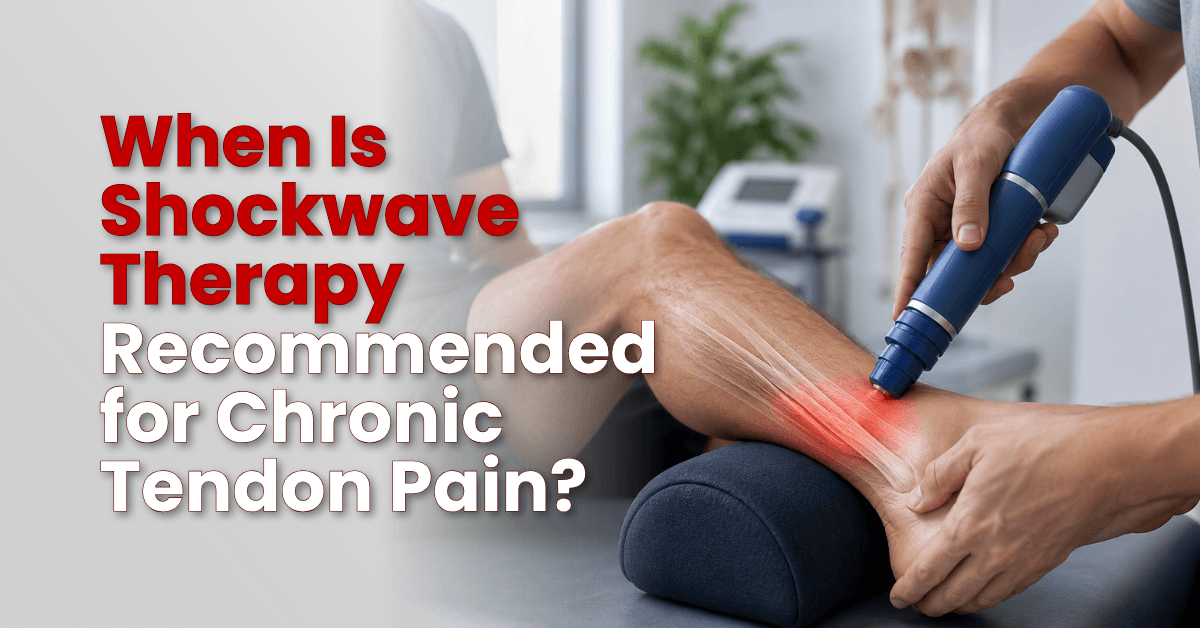
Extracorporeal shockwave therapy (ESWT) is a non-invasive treatment that delivers acoustic pressure waves through the skin to the affected tendon. No needles, no surgery, no medication. A handheld applicator is moved over the painful area, delivering rapid pulses over a few minutes.
The treatment is thought to stimulate the body’s healing response in tissue that has become stuck in a poorly healing state, which is a reasonable description of many long-standing tendon problems.
Why Chronic Tendon Pain Is Different
Tendon problems exist on a continuum. Early, reactive tendon irritation often settles with load management. But tendons that have been painful for many months can undergo structural changes and sit in a state that no longer responds the same way, which is partly why long-standing tendon pain can plateau even with good rehabilitation.
This distinction matters for shockwave, because the research on it is specifically about these chronic, persistent cases, not fresh injuries.
When Shockwave Therapy May Be Considered
Based on current evidence and clinical guidance, shockwave is generally considered when a few conditions line up:
The Pain Is Genuinely Chronic
Shockwave is typically reserved for tendon pain that has persisted for several months or more, usually at least three to six. It’s not appropriate for acute injuries or recent flare-ups, which need a different approach.
First-Line Treatment Hasn’t Delivered
Progressive loading rehabilitation, structured, gradually increasing strength work, remains the foundation of tendon treatment and is where everyone should start. Shockwave enters the conversation when a well-run loading program over several months hasn’t produced enough progress, not as a shortcut around doing the program.
The Condition Is One Where Evidence Is Stronger
Shockwave research is condition-specific, and the results vary. Systematic reviews suggest more consistent support for some conditions, including:
- Plantar heel pain (plantar fasciopathy)
- Calcific tendinopathy of the shoulder
- Some chronic lower limb tendinopathies, such as Achilles and patellar tendon pain, where reviews report it may reduce pain, particularly alongside exercise
For other conditions the evidence is more mixed, which is exactly the kind of thing a practitioner should discuss with you honestly before treatment begins.
It’s Used Alongside Rehabilitation, Not Instead of It
The most consistent theme in the research: shockwave appears most useful as an adjunct, something added to a loading program, rather than a replacement for one. The tendon still needs progressive strengthening to rebuild its capacity. Shockwave may help create a window where that work becomes more comfortable and productive.
What to Expect From Treatment
If shockwave is recommended for you:
- Sessions are short, typically a few minutes of pulses within a normal appointment
- It can be uncomfortable during delivery, often described as a rapid tapping that ranges from odd to moderately painful, and settings can be adjusted
- A course involves multiple sessions, commonly three to six, spaced about a week apart
- Mild soreness or redness afterwards is common and usually settles within a day or two
- Improvement, where it occurs, tends to be gradual over weeks rather than immediate
Your practitioner should also screen you first, as shockwave isn’t suitable for everyone. It’s generally avoided over healing fractures, infections or areas of poor sensation, during pregnancy, and in people on certain medications, which is one of several reasons it should only follow a proper assessment.
Questions Worth Asking Before You Start
Whoever provides your shockwave therapy, these questions will serve you well:
- Have I completed a genuine trial of progressive loading first?
- Is my specific condition one where the evidence supports shockwave?
- What will we do alongside the shockwave sessions?
- How will we measure whether it’s working, and what’s the plan if it isn’t?
A practitioner comfortable answering all four is a good sign.
Shockwave Therapy at Next Phase Injury Therapy
At Next Phase Injury Therapy in Yagoona, shockwave therapy is offered as part of a broader treatment plan, not as a standalone service. Our practitioners assess your tendon pain first, establish or review your loading program, and discuss whether your condition and history are ones where shockwave may be worth considering.
We work with you to:
- Assess whether your tendon pain has genuinely plateaued with first-line treatment
- Discuss honestly what the evidence says for your specific condition
- Combine any shockwave course with the rehabilitation your tendon needs long term
Tendon Pain That Won’t Budge?
If a tendon problem has hung around for months despite your best efforts, an assessment can clarify where you’re at and whether shockwave deserves a place in your plan.
Explore our shockwave therapy, physiotherapy, chiropractic and remedial massage services, or book an appointment with Next Phase Injury Therapy. We’re open 8am to 8pm, seven days a week. Yes, even Sundays.
References
- Korakakis, Vasileios, et al. “The Effectiveness of Extracorporeal Shockwave Therapy in Common Lower Limb Conditions: A Systematic Review Including Quantification of Patient-Rated Pain Reduction.” British Journal of Sports Medicine, vol. 52, no. 6, 2018, pp. 387–407, https://doi.org/10.1136/bjsports-2016-097347.
- Mani-Babu, Sethu, et al. “The Effectiveness of Extracorporeal Shock Wave Therapy in Lower Limb Tendinopathy: A Systematic Review.” The American Journal of Sports Medicine, vol. 43, no. 3, 2015, pp. 752–761, https://doi.org/10.1177/0363546514531911.
- Bannuru, Raveendhara R., et al. “High-Energy Extracorporeal Shock-Wave Therapy for Treating Chronic Calcific Tendinitis of the Shoulder: A Systematic Review.” Annals of Internal Medicine, vol. 160, no. 8, 2014, pp. 542–549, https://doi.org/10.7326/M13-1982.
- Malliaras, Peter, et al. “Achilles and Patellar Tendinopathy Loading Programmes: A Systematic Review Comparing Clinical Outcomes and Identifying Potential Mechanisms for Effectiveness.” Sports Medicine, vol. 43, no. 4, 2013, pp. 267–286, https://doi.org/10.1007/s40279-013-0019-z.
Information on this page is general in nature and is not a substitute for individualised advice from a registered health practitioner. Our practitioners are registered with AHPRA.