
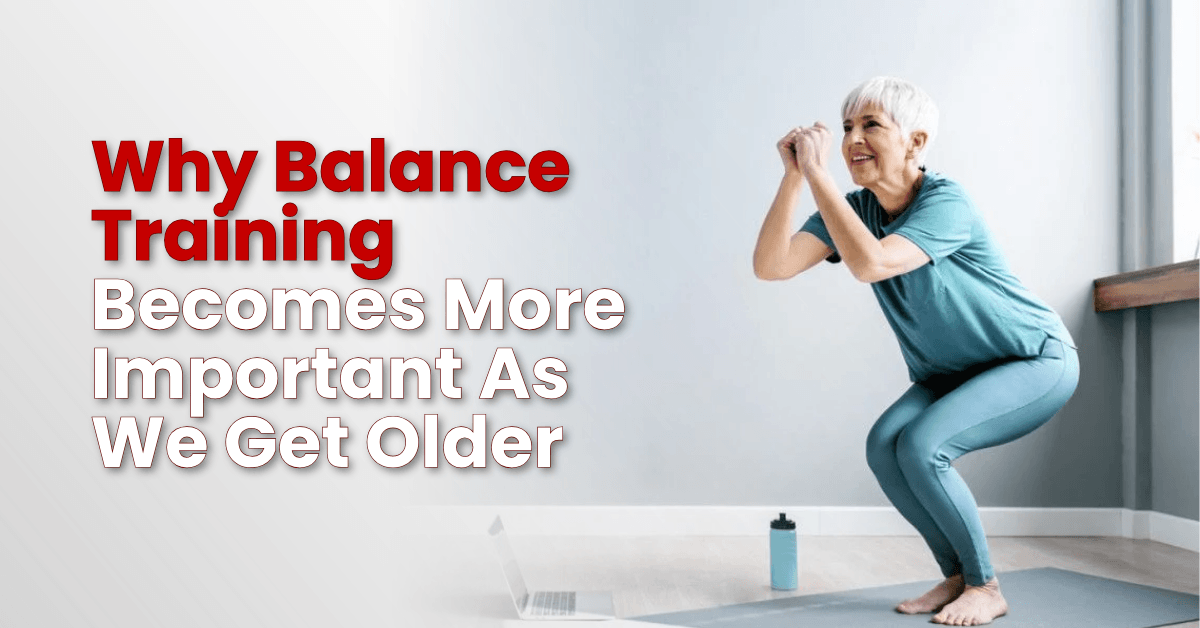
Try something: stand on one leg while you read this paragraph. If that’s noticeably harder than it used to be, you’ve just met one of ageing’s quietest changes.
Balance doesn’t announce its decline the way strength or fitness do. There’s no puffing, no struggling with jar lids. It fades in the background, usually from midlife onward, and most people only discover how much they’ve lost when a kerb, a wet floor or a moment of inattention tests it.
Here’s the part that deserves more airtime: balance is remarkably trainable, at every age, and the evidence behind training it is some of the strongest in this entire field.
Why Balance Declines With Age
Balance isn’t one ability. It’s a rapid conversation between several systems, and age gradually turns the volume down on all of them:
- Sensors in muscles and joints (proprioception) report your position less precisely
- The inner ear’s balance organs become less sensitive
- Vision, which balance leans on heavily, changes with age
- Muscle power, the fast strength needed to catch a stumble, declines earlier and faster than overall strength
- Reaction time lengthens, shrinking the window to correct a wobble
Because these decline together and gradually, the system quietly compensates for years. That’s why the loss so often goes unnoticed until it matters.
Why It Matters More With Each Decade
The stakes rise with age. Roughly one in three adults over 65 has a fall each year, and falls are a leading cause of injury in older Australians. Beyond the injuries themselves, a fall, or even a near miss, often starts a quieter problem: fear. People begin avoiding stairs, uneven ground, walking outside, and that avoidance reduces activity, which reduces strength and balance further, which increases the actual risk. It’s a spiral worth staying ahead of.
There’s a second, less discussed reason: balance is what keeps every other activity available. Bushwalks, sport, ladders, grandkids, travel, gardening on uneven ground. Confidence on your feet is the quiet permission slip for all of it.
The Good News: Balance Training Genuinely Works
This isn’t a “may help” area. Cochrane’s review of exercise for preventing falls in older people found that exercise programs reduce the rate of falls by around a quarter, and programs that challenge balance, combined with functional and strength exercises, are among the most effective. Few things in musculoskeletal health have evidence this consistent.
Balance also responds to training at any starting point, including for people who have already had falls, though programs should be matched to the individual, which is where assessment earns its place.
How to Train Balance
The principle is the same as strength: balance improves when it’s challenged just beyond comfortable, regularly and progressively.
Make Standing Harder, Gradually
Progress through positions as each becomes easy: feet together, then heel-to-toe, then single leg, then single leg with eyes closed or head turning. Hold each for 20 to 30 seconds, near a bench or wall for safety.
Train Balance in Motion
Static standing is the entry point, but life wobbles while moving. Heel-to-toe walking, stepping over objects, changing direction, gentle sidesteps, and practising getting up from the floor all train the balance you actually use.
Build Leg Strength and Power
Catching a stumble is a strength event, it demands force, fast. Sit-to-stands, step-ups, calf raises and, as capacity grows, quicker versions of these movements build the reserve that turns a trip into a stumble instead of a fall. Strength training also protects the muscle and bone that make any fall less consequential.
Consider a Structured Class
Practices like tai chi and balance-focused exercise classes have good evidence behind them, and clinical Pilates offers supervised balance, strength and control work scaled to your level, which suits people managing an existing condition or starting cautiously.
Attach It to Daily Life
The easiest program is one that hides inside your routine: single-leg standing while brushing teeth, heel-to-toe down the hallway, sit-to-stands during TV ads. Small daily doses beat occasional sessions.
Don’t Wait Until It’s Obvious
The best time to start balance training is before it feels necessary. From our 40s and 50s, the systems behind balance are already gradually changing, and capacity built early is capacity banked. If the one-leg test at the top of this article surprised you, consider that your starting signal, whatever your age.
When to Get Professional Input
It’s worth an assessment if:
- You’ve had a fall, or more than one near miss recently
- Fear of falling is changing what you’re willing to do
- You feel unsteady on stairs, slopes or uneven ground
- You’re starting balance work with an existing injury, joint replacement or health condition
See your doctor promptly if unsteadiness comes with dizziness, vertigo, new numbness in the feet, or has appeared suddenly, as these can have specific medical causes that need identifying first.
Balance and Falls Prevention at Next Phase Injury Therapy
At Next Phase Injury Therapy in Yagoona, our physiotherapists and exercise team work with people across the whole balance spectrum, from midlifers future-proofing to older adults rebuilding confidence after a fall.
We work with you to:
- Assess your balance, strength and the factors affecting them
- Build a progressive program that challenges you safely, at your level
- Rebuild the confidence that keeps you active, independent and doing what you enjoy
Steadiness Is Trainable
Balance fades quietly, but it returns with practice, and the evidence says the practice works.
Explore our physiotherapy, chiropractic, remedial massage and clinical Pilates services, or book an appointment with Next Phase Injury Therapy. We’re open 8am to 8pm, seven days a week.
References
- Sherrington, Catherine, et al. “Exercise for Preventing Falls in Older People Living in the Community.” Cochrane Database of Systematic Reviews, no. 1, 2019, https://doi.org/10.1002/14651858.CD012424.pub2.
- Rubenstein, Laurence Z. “Falls in Older People: Epidemiology, Risk Factors and Strategies for Prevention.” Age and Ageing, vol. 35, suppl. 2, 2006, pp. ii37–ii41, https://doi.org/10.1093/ageing/afl084.
- Sturnieks, Daina L., et al. “Balance Disorders in the Elderly.” Neurophysiologie Clinique/Clinical Neurophysiology, vol. 38, no. 6, 2008, pp. 467–478, https://doi.org/10.1016/j.neucli.2008.09.001.
- Chodzko-Zajko, Wojtek J., et al. “Exercise and Physical Activity for Older Adults.” Medicine & Science in Sports & Exercise, vol. 41, no. 7, 2009, pp. 1510–1530, https://doi.org/10.1249/MSS.0b013e3181a0c95c.
- Fragala, Maren S., et al. “Resistance Training for Older Adults: Position Statement from the National Strength and Conditioning Association.” Journal of Strength and Conditioning Research, vol. 33, no. 8, 2019, pp. 2019–2052, https://doi.org/10.1519/JSC.0000000000003230.
Information on this page is general in nature and is not a substitute for individualised advice from a registered health practitioner. Our practitioners are registered with AHPRA.


