
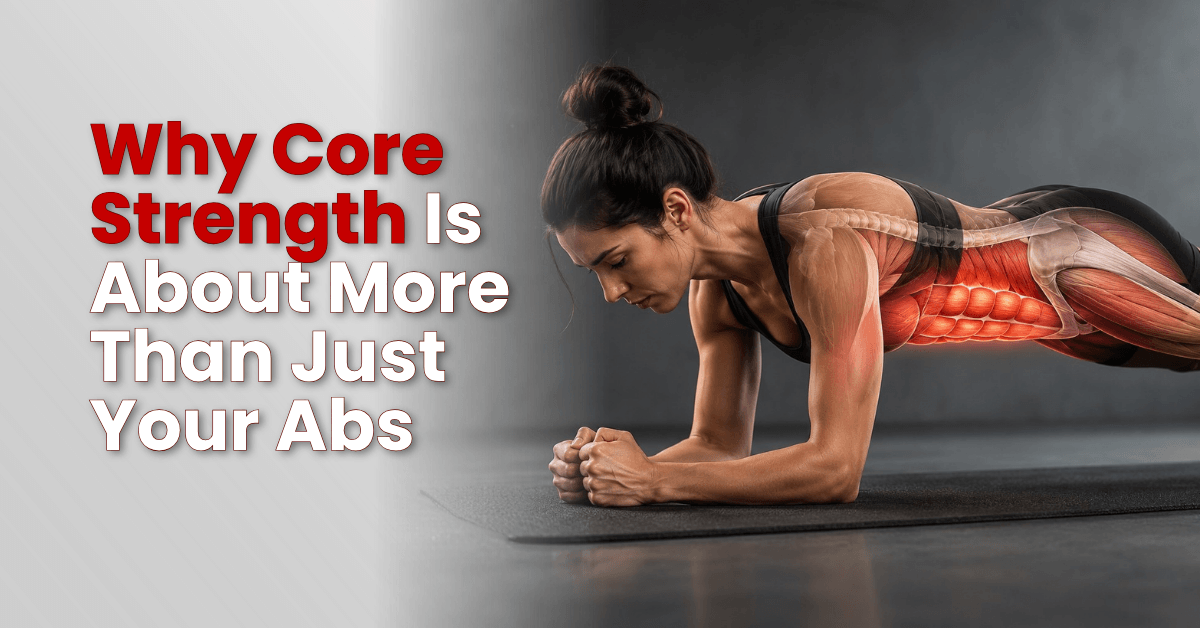
When most people hear the words core strength, they think of abs. Sit-ups, planks, six-packs and burning stomach workouts usually come to mind first.
But your core is much more than the muscles you can see in the mirror. It is the system that helps your spine, pelvis, hips and ribs work together while you move, lift, twist, run, sit, breathe and train.
That is why core strength matters for far more than appearance. It can support posture, help with movement control, assist with lower back and core exercises, and play a useful role in injury rehabilitation when it is trained properly.
Here is what core strength actually means, why it matters, and how to build it safely.
What Is Core Strength?
Core strength is your ability to control and support your trunk while your body moves.
That does not mean holding your stomach tight all day. A strong core should be able to switch on when needed, relax when appropriate, and coordinate with the rest of your body during real movement.
Good core strength helps you:
- Stay balanced while moving
- Transfer force between your upper and lower body
- Control your spine and pelvis under load
- Lift, carry, push and pull with better control
- Move with less unnecessary compensation
In practical terms, core strength is not just about doing harder ab exercises. It is about building control that carries over into daily life, sport, work and rehabilitation.
What Muscles Are Part of the Core?
The core includes more than the rectus abdominis, which is the visible “six-pack” muscle. Depending on how broadly it is defined, your core can include:
- Deep abdominal muscles, including the transverse abdominis
- Obliques, which help with rotation and side bending
- Rectus abdominis, which helps bend the trunk forward
- Multifidus and deep spinal muscles, which help control the spine
- Pelvic floor muscles, which support the pelvis from below
- Diaphragm, which plays a role in breathing and pressure control
- Glutes and hip muscles, which support pelvic stability
- Back extensors, which help support upright posture and lifting
This is why core muscles exercises should not only target your abs. A useful program usually includes abdominal strength and stability, pelvic stability exercises, hip strength, breathing control and functional movement.
Why Is Core Strength Important?
Core strength is important because most movement passes through the trunk in some way.
If you lift a box, your legs, hips, back, shoulders and arms all need to work together. If you run, your trunk helps control rotation and force transfer. If you sit at a desk all day, your core endurance can influence how easily you change positions and tolerate long periods in one posture.
Core strength may help support:
- Better movement control
- More efficient lifting and carrying
- Improved balance and coordination
- Better tolerance for training or physical work
- Lower back support during everyday tasks
- Confidence with movement after injury
It is not a magic shield against pain or injury. But when it is part of a broader program that includes strength, mobility, load management and recovery, it can be a valuable piece of the puzzle.
Core Strength for Back Pain
Core strength for back pain is one of the most common reasons people start core exercises. The idea is partly right, but it needs context.
Research supports exercise as part of managing chronic low back pain. Motor control and core stability exercises may help some people, especially when the goal is to improve control, confidence and function. However, research also suggests that core-specific exercise is not always clearly better than other well-planned forms of exercise.
That means the best approach is usually individual. Some people need core stability exercises. Others need hip strength, walking, general strength training, mobility work, education, or a mix of several things.
If your back pain keeps returning, the question is not just, “Is my core weak?” A better question is, “What does my body need to tolerate the tasks I am asking it to do?”
Core Strength for Posture
Core strength for posture is often misunderstood.
Good posture is not about forcing yourself to sit perfectly straight all day. The body is built to move, and even a “good” position can become uncomfortable if you stay there too long.
A stronger, better coordinated core may help you:
- Change positions more comfortably
- Sit or stand with less fatigue
- Control your ribs, spine and pelvis during movement
- Avoid relying on one position all day
- Build endurance for work, training and daily tasks
So instead of chasing one perfect posture, the goal is to build a body that has more options.
Core Strength for Injury Prevention
Core strength for injury prevention should be framed carefully. No exercise can guarantee you will not get injured.
That said, a well-designed core program may help reduce risk in some situations by improving control, balance and load tolerance. This is especially relevant for people returning to sport, lifting at work, changing direction, running, or managing repeated physical demands.
Functional core training is usually more useful than endless crunches because it teaches your core to work with the rest of your body. Examples include carries, bridges, controlled squats, anti-rotation exercises and movements that challenge balance and control.
Core Exercises for Beginners
If you are wondering how to build core strength from nothing, start simple. You do not need advanced planks or intense ab circuits on day one.
Good core exercises for beginners should feel controlled, repeatable and pain-free enough to perform with good technique.
Breathing and Bracing
Learning to breathe while gently engaging your trunk is often the first step. This helps you create support without holding your breath or tensing everything at once.
Dead Bug
The dead bug helps train abdominal control while your arms and legs move. It is a useful starting point for people who need core strength exercises without loading the spine heavily.
Bird Dog
The bird dog trains control through the trunk, hips and shoulders. It is often used in lower back and core exercises because it challenges stability without needing heavy equipment.
Glute Bridge
The glute bridge strengthens the hips and helps improve pelvic control. This matters because weak or poorly coordinated hip muscles can place extra demand on the lower back.
Side Plank Modification
A modified side plank can build side-body strength through the obliques and hip muscles. It can be scaled up or down depending on your starting point.
Pallof Press
The Pallof press is an anti-rotation exercise. It trains your core to resist twisting, which is useful for lifting, sport and everyday movement.
Exercises to Strengthen Core and Lower Back
Exercises to strengthen core and lower back should eventually move beyond floor-based drills.
Once the basics are comfortable, your program may include:
- Squats to a chair
- Hip hinges
- Step-ups
- Farmer carries
- Cable or band rows
- Controlled lifting patterns
- Reformer Pilates or clinical Pilates exercises
- Sport-specific or work-specific movement drills
This is where physiotherapy for core strength can be helpful. A practitioner can assess whether you need more strength, more mobility, better control, or a different progression altogether.
When to Get Professional Guidance
It is worth getting assessed if:
- Back pain keeps returning despite exercise
- Core exercises make your symptoms worse
- You feel unsure which exercises are safe for you
- You are returning after injury, surgery or a long break
- You want a program matched to your work, sport or training goals
- Pain travels down your leg, or you notice numbness, tingling or weakness
Seek prompt medical care if back pain is linked with changes in bladder or bowel control, numbness around the groin or saddle area, progressive leg weakness, fever, unexplained weight loss, or a significant fall or accident.
Core Strength Support at Next Phase Injury Therapy
At Next Phase Injury Therapy in Yagoona, our physiotherapists, chiropractors, remedial massage therapists and clinical Pilates team help people build strength in a way that suits their body, injury history and goals.
We can help with:
- Movement and posture assessment
- Physiotherapy for core strength
- Back pain treatment Yagoona
- Injury rehabilitation Yagoona
- Clinical Pilates and reformer Pilates
- Strength and mobility programs
- Return to work, gym or sport planning
The right core program should not feel random. It should match your starting point, your symptoms, and what you need your body to do.
Explore our physiotherapy and clinical Pilates services, or book an appointment with Next Phase Injury Therapy. We are open 8am to 8pm, seven days a week, including Sundays.
Frequently Asked Questions
What is core strength?
Core strength is the ability to support and control your trunk, spine and pelvis during movement. It involves your abs, back muscles, deep spinal muscles, pelvic floor, diaphragm, hips and glutes working together.
Why is core strength important?
Core strength is important because it helps with balance, lifting, posture, movement control and force transfer between the upper and lower body. It can also support rehabilitation and general strength training.
Is core strength more than just abs?
Yes. Core strength is much more than abs. Your visible abdominal muscles are only one part of the system. True core strength also involves deep trunk muscles, spinal muscles, breathing control, pelvic stability and hip strength.
What muscles are part of the core?
The core can include the transverse abdominis, obliques, rectus abdominis, multifidus, erector spinae, pelvic floor, diaphragm, glutes and hip muscles. These muscles work together to support movement and stability.
How can I build core strength from nothing?
Start with simple, controlled exercises such as breathing and bracing, dead bugs, bird dogs, glute bridges and modified side planks. Build gradually before moving into heavier or more complex core strengthening exercises.
Can core exercises help with lower back pain?
Core exercises can help some people with lower back pain, especially when they are matched to the person and progressed appropriately. They are usually most effective as part of a broader plan that may include strength, mobility, education and load management.
This article provides general information only and is not a substitute for individual clinical assessment or medical advice. Exercise needs vary depending on your symptoms, injury history, goals and health status. Please speak with a qualified health practitioner for advice tailored to your situation.
References
- Saragiotto, Bruno T., et al. “Motor Control Exercise for Nonspecific Low Back Pain: A Cochrane Review.” Spine, vol. 41, no. 16, 2016, pp. 1284–1295, https://pubmed.ncbi.nlm.nih.gov/27128390/
- Hayden, Jill A., et al. “Exercise Therapy for Chronic Low Back Pain.” Cochrane Database of Systematic Reviews, 2021, https://doi.org/10.1002/14651858.CD009790.pub2
- Lin, Ivan, et al. “What Does Best Practice Care for Musculoskeletal Pain Look Like? Eleven Consistent Recommendations from High-Quality Clinical Practice Guidelines.” British Journal of Sports Medicine, vol. 54, no. 2, 2020, pp. 79–86, https://doi.org/10.1136/bjsports-2018-099878
- Huxel Bliven, Kellie C., and Barton E. Anderson. “Core Stability Training for Injury Prevention.” Sports Health, vol. 5, no. 6, 2013, pp. 514–522, https://pmc.ncbi.nlm.nih.gov/articles/PMC3806175/
- Kibler, W. Ben, Joel Press, and Aaron Sciascia. “The Role of Core Stability in Athletic Function.” Sports Medicine, vol. 36, no. 3, 2006, pp. 189–198, https://doi.org/10.2165/00007256-200636030-00001
Information on this page is general in nature and is not a substitute for individualised advice from a registered health practitioner. Our practitioners are registered with AHPRA.


