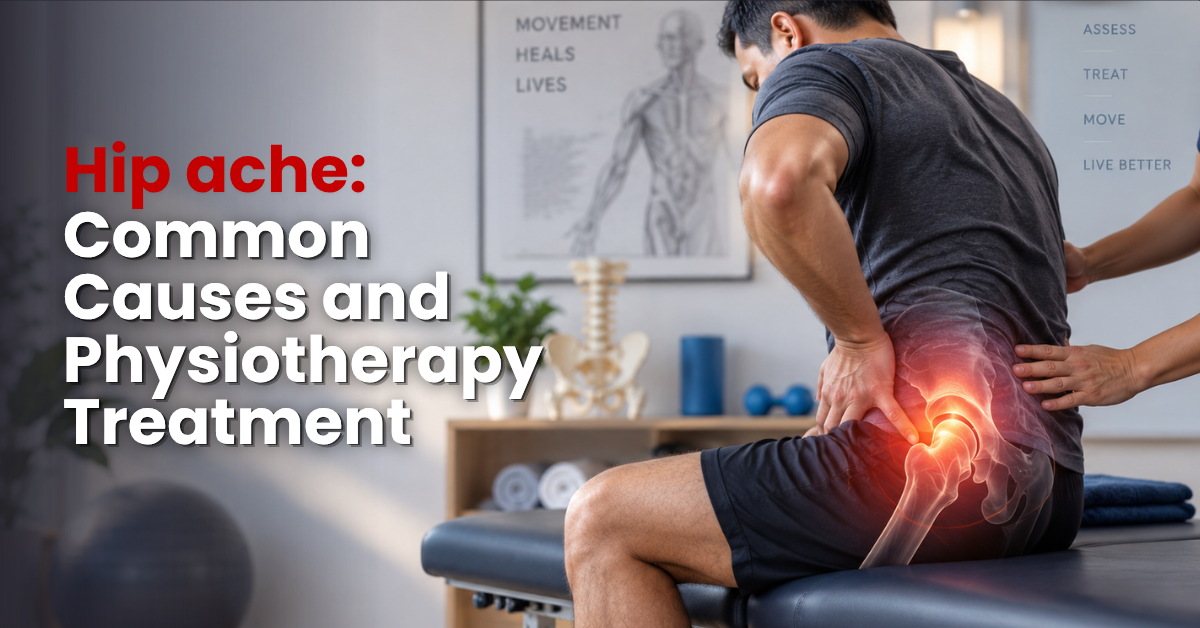
Hip ache can be frustrating because it rarely stays in one neat spot.
It might feel like a deep ache in the front of the hip, a sharp pinch in the groin, soreness on the outside of the hip, stiffness after sitting, or discomfort that spreads into the buttock, thigh or lower back.
Sometimes hip ache starts after a clear moment, like a fall, awkward twist, gym session or sports injury. Other times, it builds slowly until walking, standing, stairs, running or sleeping on one side becomes uncomfortable.
Understanding the possible causes of hip ache can help you decide when to modify activity, when to keep moving carefully, and when to see a physiotherapist for a proper assessment.
What Is Hip Ache?
Hip ache refers to pain, stiffness, soreness or discomfort around the hip joint and surrounding muscles.
People may feel hip discomfort in different areas, including:
- The front of the hip or groin
- The outside of the hip
- The buttock area
- The side of the thigh
- The lower back or pelvis
- Deep inside the hip joint
Where the pain is felt can give clues, but it does not always tell the full story. Hip pain can come from the hip joint itself, nearby muscles, tendons, bursae, the lower back, the pelvis, or a combination of factors.
Common Hip Discomfort Symptoms
Hip ache symptoms can vary depending on the cause and how long the problem has been present.
Common symptoms include:
- Aching around the hip or groin
- Sharp pain with certain movements
- Stiffness after sitting
- Pain walking uphill or upstairs
- Pain when getting in or out of the car
- Soreness when lying on one side
- Reduced hip mobility
- Clicking, catching or pinching
- Weakness or reduced confidence with movement
- Pain that worsens after sport, running or long walks
If hip pain is persistent, worsening or affecting normal activities, it is worth getting assessed.
Why Is My Hip Hurting?
There is not always one single reason for hip ache. Often, several things contribute at the same time.
Common causes of hip ache include muscle strain, tendon pain, joint stiffness, hip joint irritation, overload from activity, movement patterns, previous injury or pain referred from the lower back.
The right treatment depends on what is driving the symptoms. That is why guessing the cause from pain location alone can be misleading.
Muscle Strain Around the Hip
A muscle strain can happen when muscle fibres are overstretched or overloaded.
Hip-related muscle strains may involve the hip flexors, glutes, adductors, hamstrings or muscles around the pelvis. They can happen during running, kicking, lifting, gym training, sudden changes of direction or awkward movement.
A hip muscle strain may feel like:
- Sudden pain during activity
- Tightness or soreness after exercise
- Pain when lifting the knee
- Pain when pushing off, squatting or lunging
- Bruising or tenderness in more significant cases
Mild strains may settle with sensible load changes, but repeated strains or pain that limits walking, sport or work should be assessed.
Tendon Pain Around the Hip
Tendon pain often develops gradually. It may start as a small ache and become more noticeable with repeated loading.
Common tendon-related hip problems can involve the gluteal tendons on the outside of the hip, the hip flexor tendons at the front, or the adductor tendons near the groin.
Tendon pain may be linked with:
- Sudden increases in walking, running or stairs
- Hill walking or running
- Repeated squats or lunges
- Sitting with the hip compressed for long periods
- Sleeping on the sore side
- Returning to activity too quickly after a break
Tendon-related hip pain often needs a structured loading plan. Rest may reduce symptoms temporarily, but strength and capacity usually need to be rebuilt gradually.
Hip Joint Stiffness and Joint Issues
The hip joint is designed to move in several directions. When mobility is reduced, the body may compensate through the lower back, pelvis, knees or ankles.
Hip joint issues may feel like:
- Deep ache in the groin
- Stiffness after sitting
- Reduced range of motion
- Difficulty putting on shoes or socks
- Pain with squatting or twisting
- Catching or pinching in the hip
- Pain that gradually increases over time
Joint-related hip pain can be influenced by age, activity, previous injury, hip shape, strength, mobility and conditions such as osteoarthritis. A physiotherapist can assess movement, strength and function, and may recommend GP review or imaging if needed. Age-related changes in mobility can also contribute to stiffness and movement limitations. Understanding how flexibility can change with age may help you identify practical ways to maintain movement and function.
Hip Pain on the Outside of the Hip
Pain on the outside of the hip is often linked with irritation around the gluteal tendons or nearby soft tissues. It is sometimes described as greater trochanteric pain syndrome.
This type of hip pain may be worse with:
- Lying on the painful side
- Climbing stairs
- Walking uphill
- Standing on one leg
- Running
- Sitting with legs crossed
- Sudden increases in walking or exercise
Treatment often focuses on reducing irritating loads, improving hip strength, reviewing movement patterns and gradually rebuilding tolerance.
How Activity, Posture and Movement Can Contribute
Hip pain is not always about one wrong movement or one bad posture.
The hip is affected by how much load it receives, how often it receives it, and whether the surrounding muscles are prepared for that demand.
For example:
- Sitting for long periods may contribute to stiffness
- A sudden increase in steps can overload the hip
- Hill running or stairs can increase tendon load
- Squats, lunges or heavy lifting may flare symptoms if progressed too quickly
- Poor sleep and recovery can reduce tissue tolerance
- Repeated movement patterns can irritate sensitive structures
A physiotherapist can help identify which movements are currently sensitive, which ones are safe to continue, and how to rebuild capacity without guessing.
Hip Injury: Acute Pain vs Persistent Hip Pain
Hip pain can be acute or persistent.
Acute Hip Pain
Acute hip pain usually starts suddenly. It may happen after a fall, sports injury, twist, collision, heavy lift or sudden movement.
It may involve muscle strain, joint irritation, bruising, ligament injury or, less commonly, a fracture or more serious injury.
Significant pain after a fall, inability to bear weight, major swelling, deformity or severe restriction should be assessed urgently.
Persistent Hip Pain
Persistent hip pain develops slowly or lasts longer than expected.
It may involve tendon pain, joint stiffness, osteoarthritis, movement patterns, strength deficits, referred pain from the lower back or a previous injury that was never fully rehabilitated.
If hip ache has lasted more than a few weeks, keeps returning, or is affecting walking, stairs, sleep, work or exercise, a professional assessment can help clarify the next step.
When Should You See a Physiotherapist for Hip Pain?
You should consider seeing a physiotherapist if hip ache is not improving, keeps returning, or is affecting your normal activities.
- Hip pain is not improving after a few days to a couple of weeks
- Pain keeps returning with walking, running or training
- You have pain on stairs, hills or when standing on one leg
- You cannot sleep comfortably on one side
- Your hip feels stiff or restricted
- Pain is changing the way you walk
- You feel weak, unstable or unsure with movement
- You have had a hip injury and want to return to sport
- You are relying on pain relief more often than usual
- You are unsure whether to rest or keep moving
Seek urgent medical care if hip pain follows a fall or significant injury, you cannot bear weight, there is major swelling or deformity, pain is severe and worsening, or you feel unwell with fever, redness or heat around the joint.
Can Physiotherapy Help With Hip Pain?
Physiotherapy may help with hip pain by assessing what is contributing to the symptoms and guiding a plan that matches your presentation.
A physiotherapy treatment plan for hip pain may include:
- Hip mobility assessment
- Strength testing
- Movement and walking assessment
- Education about the likely drivers of pain
- Load management advice
- Manual therapy where appropriate
- Hip mobility exercises
- Strengthening exercises
- Rehabilitation for sport, work or daily tasks
- Return-to-activity planning
The aim is not just to settle symptoms in the short term. It is to help improve hip mobility, strength and function so the hip can better tolerate what you need it to do.
Physiotherapy Treatment for Hip Pain
Physiotherapy treatment for hip pain should be based on assessment, not a generic list of exercises.
Depending on your symptoms, your physiotherapist may focus on:
Hip Mobility
Mobility exercises may help improve how the hip moves, especially if stiffness is contributing to discomfort or compensation elsewhere.
Strengthening Exercises
Strengthening exercises may target the glutes, hip flexors, adductors, hamstrings, calves, core or surrounding lower limb muscles depending on the cause of pain.
Load Management
This means adjusting walking, running, gym training, stairs or sport so the hip can settle while still maintaining safe movement where possible.
Movement Patterns
Your physiotherapist may look at how you squat, walk, run, climb stairs, lunge or perform work-related tasks. Small changes may reduce irritation and improve confidence.
Manual Therapy
Manual therapy may be used to support short-term pain relief, reduce stiffness or improve movement when appropriate. It is usually most useful when combined with exercise and education.
Rehabilitation
Rehabilitation is the process of gradually rebuilding strength, mobility, confidence and function. For athletes or active people, this may include running, jumping, lifting, cutting or sport-specific drills.
What About Chiropractic, Clinical Pilates and Manual Therapy?
Hip pain care may involve different approaches depending on what the assessment finds.
Physiotherapy
Physiotherapy can help assess hip movement, strength, pain triggers and function, then guide a rehabilitation plan.
Chiropractic
Chiropractic care may be considered where hip, pelvic or spine-related stiffness and movement issues are contributing to symptoms. Care should be matched to the person and used where appropriate.
Clinical Pilates
Clinical Pilates may support hip strength, pelvic control, mobility and movement confidence, especially when a supervised and structured exercise approach is suitable.
Manual Therapy
Manual therapy may help some people with pain and stiffness, particularly when combined with a broader plan that includes movement, strengthening and load management.
Hip Pain Support at Next Phase Injury Therapy
At Next Phase Injury Therapy in Yagoona, we support people with hip ache, hip discomfort symptoms, hip injury, tendon pain, muscle strain, joint stiffness and movement-related pain.
Our team can help with:
- Physiotherapy treatment for hip pain
- Hip mobility and strength assessment
- Rehabilitation after hip injury
- Strengthening exercises
- Load management for work, gym or sport
- Clinical Pilates where appropriate
- Chiropractic care where appropriate
- Manual therapy as part of a broader plan
- Return to walking, running, training or sport planning
If you are asking, “Why is my hip hurting?” a proper assessment can help identify what may be contributing to your symptoms and what steps may be appropriate.
Explore our physiotherapy service, chiropractic care, clinical Pilates or manual therapy. You can also book an appointment online.
Next Phase Injury Therapy is located at 444 Hume Highway, Yagoona NSW 2199, with parking at the rear. We are open 8am to 8pm, seven days a week.
FAQs
What is the most common cause of hip pain?
The most common cause depends on age, activity level and pain location. Common causes include muscle strain, tendon pain, joint stiffness, hip joint irritation, osteoarthritis, overuse or referred pain from the lower back. Assessment can help identify what is most likely in your situation.
Can physiotherapy help with hip pain?
Physiotherapy may help with hip pain by assessing mobility, strength, movement patterns and activity load, then guiding exercises, manual therapy where appropriate and a gradual rehabilitation plan.
When should I see a physiotherapist for hip pain?
Consider seeing a physiotherapist if hip pain is not improving, keeps returning, affects walking, stairs, sleep or exercise, or changes how you move. Seek urgent medical care if you cannot bear weight, have severe pain after a fall, or notice major swelling, deformity, fever or worsening symptoms.
Why is my hip hurting?
Hip pain can come from the hip joint, surrounding muscles, tendons, bursae, the pelvis or the lower back. It may be linked with injury, overuse, stiffness, weakness, activity changes or underlying joint conditions.
What exercises help with hip pain?
Exercises depend on the cause of pain. They may include hip mobility drills, glute strengthening, hip flexor or adductor strengthening, balance exercises, clinical Pilates or sport-specific rehabilitation. Exercises should be matched to your symptoms and tolerance.
Can hip pain go away on its own?
Some mild hip pain may settle with time, activity changes and gentle movement. If pain persists, worsens, keeps returning or affects daily function, it is worth getting assessed.
This article provides general information only and is not a substitute for individual clinical assessment or medical advice. Hip pain can have different causes, and treatment or exercise should be tailored to your symptoms, health history, work demands and goals. If symptoms are severe, worsening or not improving, speak with a qualified health practitioner.
References
- Next Phase Injury Therapy. Physiotherapy. https://npit.com.au/services/physiotherapy/
- Next Phase Injury Therapy. Chiropractic. https://npit.com.au/our-services-physiotherapy-chiropractic-sydney/chiropractor-sydney-expert-chiropractic-care/
- Next Phase Injury Therapy. Clinical Pilates. https://npit.com.au/services/clinical-pilates/
- Next Phase Injury Therapy. Manual Therapy Explained. https://npit.com.au/manual-therapy-explained/
- Healthdirect Australia. Hip Pain. https://www.healthdirect.gov.au/hip-pain
- Healthdirect Australia. Greater Trochanteric Pain Syndrome. https://www.healthdirect.gov.au/greater-trochanteric-pain-syndrome-gtps
- RACGP. Guideline for the Management of Knee and Hip Osteoarthritis. https://www.racgp.org.au/getattachment/71ab5b77-afdf-4b01-90c3-04f61a910be6/Guideline-for-themanagement-of-knee-and-hiposteoarthritis.aspx
- Moseng, Trine, et al. “Effect of Exercise Therapy in Patients with Hip Osteoarthritis: A Systematic Review and Cumulative Meta-analysis.” Osteoarthritis and Cartilage Open, 2023. https://pmc.ncbi.nlm.nih.gov/articles/PMC9932106/
Information on this page is general in nature and is not a substitute for individualised advice from a registered health practitioner. Our practitioners are registered with AHPRA.